


Introduction to atomic structure
As far as the structure of the atom is concerned, the first attempt was made by John Dalton in 1803. He put forward an atomic theory, which is called Dalton’s atomic theory. Following are the postulates of Dalton’s atomic theory:
- Every matter is composed of extremely small, indivisible and discrete particles called atoms.
- Atoms can neither be created nor be destroyed in a chemical reaction.
- Atoms of the same element are identical in all respects.
- Atoms of different elements have different masses and properties.
- Two or more atoms combine in a simple whole-number ratio to form a compound atom (now called molecules).
- The compound atoms of a compound are identical in all respects.
Fundamental particles of an atom
1. Electron
Electron is discovered by J.J. Thomson through a cathode ray discharge tube experiment.
The properties of cathode rays are:
- Cathode rays are a stream of negatively charged particles.
- They travel in a straight line.
- They are deflected by electric and magnetic fields towards the anode.
- They produce a heating effect when they strike then metal foil.
- They have the property to ionize the gas through which they pass.
Later on, it was found that cathode rays are nothing but a stream of an electron. Thus an electron is a negatively charged particles having a unit negative charge and mass is equal to 1/1837 of a hydrogen atom. Mass of electron = 9.09 x 10⁻²⁸ gm.
2. Proton
Proton is discovered by E. Goldstein in 1886 through an anode ray discharge tube experiment.
Properties of anode rays are:
- They consist of positively charged particles.
- They travel in a straight line.
- They are deflected by electric and magnetic field towards the cathode.
- They cause a heating effect.
The observation above concludes that anode rays are positively charged protons. Thus, a proton is a positively charged particles having a unit positive charge and mass equal to that of a hydrogen atom. Mass of proton = 1.67 x 10⁻²⁴ gm.
3. Neutron
Neutron is discovered by James Chadwick in 1932 by bombarding α – particles on a thin sheet of beryllium. A highly penetrating neutral particle was observed called a neutron.
2He4 + 4Be9 → 6C14 + 0n1
Thus a neutron is an electrically neutral particle having a mass nearly equal to that of a hydrogen atom. Mass of neutron=1.67 x 10⁻²⁴ gm.
Rutherford’s atomic model (alpha particle scattering experiment)
This model is put forward by Ernest Rutherford in 1911 with the help of an alpha particle scattering experiment. In this experiment, he bombarded a thin sheet of gold foil with alpha particles (positive particles equal to helium ion) which were obtained from a radioactive substance. The scattered alpha particles were observed on the surface of the circular zinc sulphide screen. Lead can absorb alpha particles. So lead plate with a slit was used to obtain a beam of alpha particles.

Observations
- Most of the alpha particles passed through the gold foil without deflection.
- Some of the alpha particles deflected through small angles.
- Very few alpha particles were deflected through angles more than 90° or bounced back.
Inference
- Most of the space inside the atom is empty.
- There is a presence of a heavy positively charged body at the centre of the atom.
- There is a close encounter of alpha particles with a positively charged body.

Postulates
- An atom consists of a positively charged nucleus at which the entire mass is concentrated and its size is extremely small as compared to the size of the atom.
- The space between the nucleus and revolving electron is empty.
- The centrifugal force of the revolving electron is balanced by the electrostatic force of attraction between the electron and nucleus.
Limitations
- It could not explain the stability of an atom:
According to the law of thermodynamics, any accelerated charged particles must emit radiation. Charged particles such as an electron in motion lose energy continuously and their energy should decrease gradually. Then electron should ultimately fall into the nucleus and should collapse. But this could not happen.

Bohr’s atomic model
In 1913, Neil Bohr proposed an atomic model to overcome the limitations of Rutherford’s atomic model of the atom. The postulates of Bohr’s atomic model are:
- Electrons revolve around the nucleus in a defined circular path called orbits. The electrostatic force of attraction between the revolving electron and nucleus is equal to the centrifugal force acting on the electron.
- As long as the atom remains in a particular orbit, it will neither gain nor lose energy and hence the energy of the electron in a particular orbit remains constant. This means these orbits are non-radiating and thus called stationary state or energy level and designated as K, L, M, N, etc.
- Only those orbits are permitted in an atom whose angular momentum of the electron is equal to the whole number multiple of h/2π where h is Plank’s constant.
Angular\ momentum\ (mvr) = \frac{nh}{2 \pi}\\ \begin {align*} where,\ m &= mass\ of\ electron\\ v &= velocity\ of\ electron\\ r &= radius\ of\ orbit\\ n &= 1,2,3,....\\ h &= Planck's\ constant = 6.67 \times 10^{-27} erg\ sec \end{align*}- Energy is emitted or absorbed by the electron in the form of a photon only when it jumps from one energy level to another. The quantum or photon of energy absorbed or emitted is the difference between the higher and lower energy level.
\Delta E = E_{2}-E_{1} = h\nu \\ \begin {align*} \Delta E &= energy\ emitted\ or\ absorbed\\ E_{2} &= higher\ energy\ level\\ E_{1} &= lower\ energy\ level\\ h &= Plank's\ constant\\ \nu &= frequency\ of\ radiation \end {align*}Energy is absorbed when an electron jumps from lower to higher energy level and energy is emitted when an electron jumps from higher to lower energy level.
Origin of hydrogen spectrum
When hydrogen gas is taken in a discharge tube and high voltage is applied, then there is the dissociation of hydrogen molecule into hydrogen atoms. Although hydrogen consists of only one electron, it produces different types of spectra. When energy is supplied, the electron of the hydrogen atom absorbs energy and jumps to a high energy level. The electrons in high energy level (excited state) are unstable and jump to lower energy level with the emission of electromagnetic radiation which give rise to line spectra called spectral series.
The equation to calculate the wavelength of different spectral series is:
\frac{1}{\lambda} = R\left [ \frac{1}{n_{1}^{2}}\ - \frac{1}{n_{2}^{2}}\ \right ]\\ \begin {align*} where, \lambda &= wavelength\\ R &= Rydberg\ constant\\ & n_{1}\ and\ n_{2}\ are\ energy\ level. \end{align*}Different types of spectral series are given below:
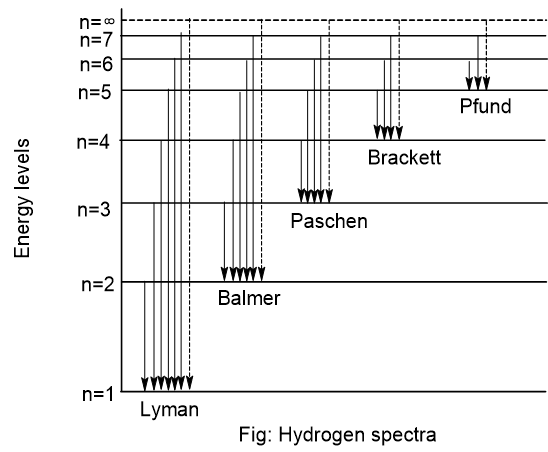
- Lyman series (92-120 nm):
It is observed when an electron jumps from a higher energy level to the first energy level. It lies in the ultraviolet region. - Balmer series (400-650 nm):
It is observed when an electron jumps from a higher energy level to a second energy level. It lies in the visible region. - Paschen series (950-1875 nm):
It is observed when an electron jumps from a higher energy level to a third energy level. It lies in the infrared region. - Brackett series (1945-4050 nm):
It is observed when an electron jumps from a higher energy level to a fourth energy level. It lies in the infrared region. - Pfund series (above 4050 nm):
It is observed when an electron jumps from a higher energy level to a fifth energy level. It lies in the infrared region.
Significance of Bohr’s atomic model
- It explains the stability of the atom.
- It explains the origin of line spectra of the hydrogen atom.
Limitations of Bohr’s atomic model
- No explanation for the multi-electron system:
This model only explained the origin of spectra of the hydrogen atom and hydrogen-like ions like He+, Li++, etc., but it doesn’t explain the origin of the spectra of the multi-electron system. - No explanation of the hyperfine structure of spectra:
When the hydrogen spectra are observed with the help of a spectroscope of high resolving power, it is found that the individual spectral lines are not really single but consist of several closely packed lines called hyperfine lines. These fine lines cannot be explained by this model. Such structure means that in a given orbit, there are several orbits called sub-orbits having different energies. - No explanation of Zeeman and Stark effect:
The splitting of spectral lines in presence of a magnetic field is called the Zeeman effect and the splitting of spectral lines in presence of an electric field is called the Stark effect. Bohr’s atomic model didn’t explain such effects. - No explanation for the dual nature of electron:
This model has treated electron as a particle of a certain mass revolving around the nucleus in a fixed orbit. But de-Broglie suggested that electron has a dual nature i. e. electron behaves as a particle as well as wave nature.
Dual nature of matter (de-Broglie equation)
In 1905, Einstein suggested the dual nature of light. According to this, light possesses a wave and particle nature. In 1924, de-Broglie advanced the idea that not only photons or light but also matter like electron shows the dual nature. The wave associated with matter is the matter wave or de-Broglie wave. So, the electron is a subatomic particle that can behave sometimes as a particle and sometimes as a wave.
The wave particle duality of matter led de-Broglie to derive the equation λ = h/P which indicates the wave and particle nature of the matter in motion.
Derivation
According to Planck’s quantum theory,
E = h\nu\ --- (i)\\ E=energy\ of\ photon,\\ h=Planck's\ constant\\ \nu=frequencyAccording to Einstein equation,
E = mc2 —- (ii)
m=mass, c=velocity of light
Combining eqn (i) and (ii),
\begin {align*} h\nu &= mc^{2}\\ or,\ h\frac{c}{\lambda} &= mc^{2} \ (\nu = c/\lambda\ and\ \lambda = wavelength)\\ or,\ \lambda &= \frac{h}{mv}\\ \lambda &= \frac{h}{P}\ (P\ is\ momentum\ and\ P=mv) \end{align*}It is de-Broglie wave equation. It shows that the momentum of a particle in motion is inversely proportional to its wavelength.
Significance
i. It shows the relation between particle and wave character of matter.
ii. It is applicable for all matter but more significant for microscopic particles like electron.
iii. It helps to deduce Bohr’s condition for quantization of angular momentum.
Differences between particle and wave
| Particle | Wave |
|---|---|
| A particle occupies a particular space. eg. a pen occupies a particular space. | A wave spreads in space. eg. sound of mike reaches everywhere. |
| No two or more particles occupy the same space at the same time. | Two or more wave co-exists in the same region at the same time. |
| When many particles are in space, the total volume is equal to the sum of their volume. | When many waves are present, the resultant wave can be greater or smaller than each individual wave. |
Heisenberg uncertainty principle
It states that “It is impossible to determine the position and momentum of microscopic particles like an electron simultaneously and accurately”.
Mathematically,
\Delta x \cdot \Delta y \geq \frac{h}{4\pi}\\ \Delta x = uncertainty\ in\ position\\ \Delta y = uncertainty\ in\ momentumUncertainty means
i. If we measure the position more accurately, then the uncertainty in momentum occurs.
ii. If we measure the momentum more accurately, then the uncertainty in position occurs.
Concept of orbital
The space around the nucleus where the probability of finding the electron is maximum is called orbital.
Differences between orbit and orbital
| Orbit | Orbital |
|---|---|
| It is the well defined circular path where the electron revolves around the nucleus. | It is the space around the nucleus where the probability of finding the electron is maximum. |
| Orbits are circular in shape. | Orbitals have a different shape. |
| Orbit uses a two-dimensional concept. | Orbitals use three-dimensional concept. |
| Orbits don’t have directional characteristics. | Orbitals have directional characteristics except for s-orbitals. |
| One orbit can accommodate a maximum of 2n2 number of electron where n is the principal quantum number. | One orbital can accommodate a maximum of two electrons. |
| Orbit concept can’t explain the geometry of a molecule. | The orbital concept explains the geometry of a molecule. |
| It is developed by Bohr’s atomic model. | It is developed by the Heisenberg uncertainty principle. |
Shape of s and p orbital
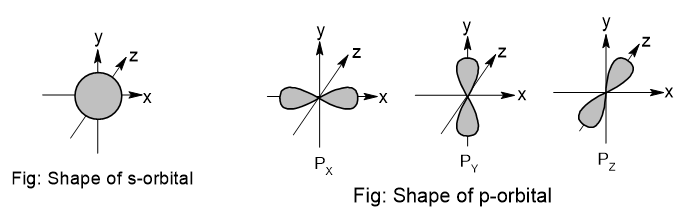
s-orbitals are spherical in shape and p-orbitals are dumb-bell shape.
Quantum numbers
The quantum mechanical parameters which tell us about the location and motion of an electron in an atom are called quantum numbers. It gives complete information of a particular electron relating to its energy level, shape and orientation of orbital with its spin. The quantum number are as follows:
1. Principal quantum number (n)
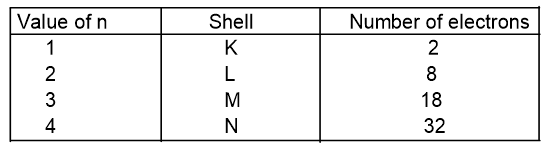
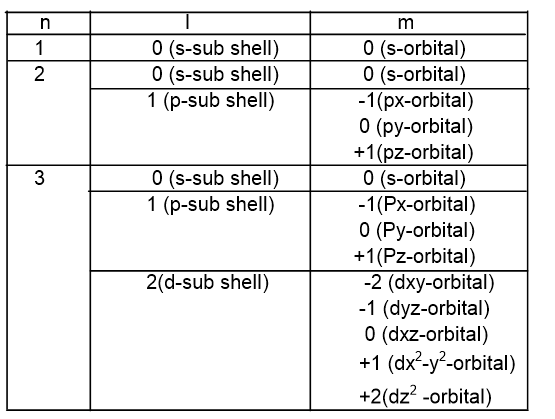
It represents the number of shells or orbit or energy level in an atom. One orbit can accommodate a maximum of 2n2 number of electron where n is principal quantum number (given by Bohr Bury rule).
2. Azimuthal quantum number (l)
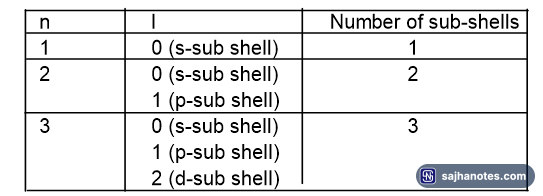
It describes the sub-shell or sub energy level. Its value lies from 0 to (n-1) for the value of n. It is also called a subsidiary quantum number.
3. Magnetic quantum number (m)
It gives information about the number of orbitals in a sub-shell. For the value of l, there are (2l+1) number of orbitals with the value of m from -l to +l.
4. Spin quantum number
It denotes the spin of an electron on its own axis. For clockwise spin, +1/2 and for an anti-clockwise spin, -1/2 is assigned.
Arrangement of electron in atomic orbitals
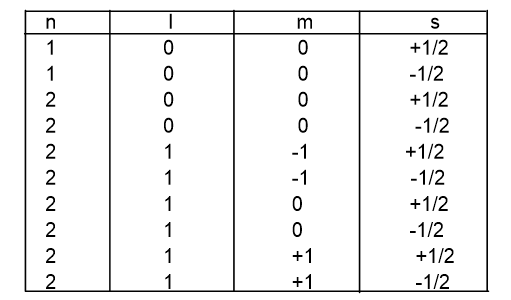
1. Pauli’s exclusion principle
It states that “No two electrons in an atom can have identical set of four quantum numbers”.
2. Hund’s rule for maximum multiplicity
It states that “In an orbital of the same sub-shell, electrons are filled singly first before pairing starts”. Illustration: Let us take an example of the filling of electrons in a nitrogen atom. The electronic configuration of nitrogen is 1s 2s 2p. There are the following possibilities in filling the electrons in 2p.

3. Aufbau principle
It states that “The orbitals are filled up with electrons in the increasing order of their energy”.
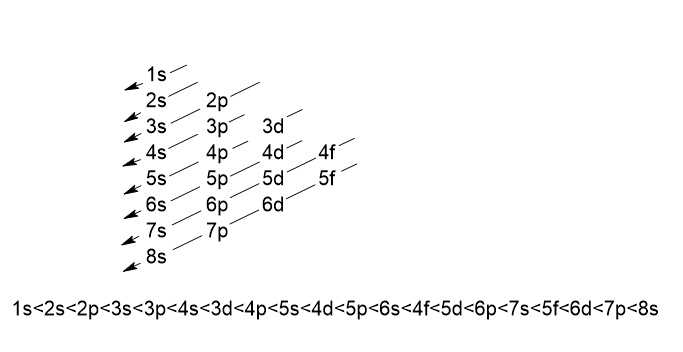
The above sequence can also be satisfied by the Madelung rule which is also called the (n+l) rule.
According to the rule:
- The orbitals with lower (n+I) value has lower energy than the orbitals of higher (n+l) value.
For 4s orbital, n = 4, l = 0, n+l=4
For 3d orbital, n = 3, l = 2, n+l=5 - When two orbitals have the same (n+l) value, the orbitals with a lower value of n has lower energy.
For 3d orbital, n = 3, l = 2, n+l=5
For 4p orbital, n = 4, l = 1, n+l=5
3d orbitals have less value of n. so it is filled first.
Limitations of Aufbau principle
Exactly half filled and full filled orbitals have greater stability than other due to following reasons:
- Symmetry: Half filled and full filled orbitals are more symmetrical than any other and symmetry lead to stability.
- Exchange energy: The electrons present in different orbitals of the same subshell can exchange their position. Each such exchange leads to a decrease in energy known as exchange energy. Greater the number of exchanges, the greater the exchange energy and the greater the stability.
Electronic configuration of elements in ground state

Electronic configuration of some ions
Fe++ = 1s2 2s2 2p6 3s2 3p6 4s0 3d6
Fe+++ = 1s2 2s2 2p6 3s2 3p6 4s0 3d5
Q. Write all quantum numbers for 3d and 2p .
| For 3d : n = 3 l = 2 m = -2, -1, 0, +1, +2 s = +1/2, -1/2 | For 2p : n = 2 l = 1 m= -1, 0, +1 (any one ) s = +1/2 or -1/2 |
Some Important Questions
- What are the observations of Rutherford’s atomic model?
- What are the postulates of Bohr’s atomic model?
- Draw a well-labelled diagram showing different spectra of the hydrogen atom.
- What is dual nature? State Heisenberg uncertainty principle.
- State Hund’s rule, aufbau rule and Pauli’s rule.
- Write all quantum numbers of 3s1, 2p4 and 3d3.
- Write the electronic configuration of iron in Fe(OH)2 and Fe(OH)3.
- What are degenerate orbitals? What is the quantization of angular momentum means?



Questions & discussion 2
Ask a question, share feedback on this note, or help another student with an answer.
This note is best for all level of student ( according to understand)
Hi Arvind,
Thank you for your feedback. Glad that it has been of help to you!