


Derivatives of carboxylic acids
A. Acid halide (R-COX): Acid chloride (R-COCl) or acid bromide (R-COBr)

Preparation
From carboxylic acid: Carboxylic acid reacts with PCl3, PCl5 or SOCl2 to give acid chloride.


Physical properties
- Lower members are colourless liquids having irritating odour and higher members are colourless solid.
- Acid chlorides are insoluble in water due to lack of intermolecular hydrogen bonding with water.
- The boiling point of acid chloride is less than parant acid due to absence of hydrogen bonding. Formyl chloride (HCOCl) is unstable.
Chemical properties
1. Action with water
\begin{align*}RCOCl+H_{2}O &\xrightarrow[]{H^{+}}RCOOH + HCl\\ \underset{\substack{Ethanoyl\\ chloride}}{CH_{3}COCl} + H_{2}O &\xrightarrow[]{H^{+}} \underset{\substack{Ethanoic\\ acid}}{CH_{3}COOH} + HCl \end{align*}2. Action with ammonia
\begin{align*}RCOCl+NH_{3} &\rightarrow RCONH_{2} + HCl\\ CH_{3}COCl + NH_{3} &\rightarrow \underset{Ethanamide}{CH_{3}CONH_{2}} + HCl \end{align*}3. Action with alcohol
\begin{align*}RCOCl+ROH &\rightarrow RCOOR + HCl\\ CH_{3}COCl + C_{2}H_{5}OH &\rightarrow \underset{\substack{Ethyl\\ ethanoate}}{CH_{3}COOC_{2}H_{5}} + HCl \end{align*}4. Rosenmund reduction
\begin{align*}RCOCl+H_{2} &\xrightarrow[]{Pd/BaSO_{4}} RCHO + HCl\\ CH_{3}COCl + H_{2} &\xrightarrow[]{Pd/BaSO_{4}} \underset{Ethanal}{CH_{3}CHO} + HCl \end{align*}5. Reduction to alcohol
CH_{3}COCl+4[H]\xrightarrow[]{LiAlH_{4}} \underset{Ethanol}{CH_{3}CH_{2}OH}+HCl6. Action with amines

B. Acid amide (RCONH2)


Preparation
1. From carboxylic acid

2. From partial hydrolysis of alkanenitrile
\begin{align*} R-CN+H_{2}O &\xrightarrow[]{H^{+}} R-CONH_{2}\\ \underset{Ethanenitrile}{CH_{3}-CN} + H_{2}O &\xrightarrow[]{H^{+}} \underset{Ethanamide}{CH_{3}-CONH_{2}} \end{align*}Physical properties
- Almost all amides are colourless, odourless and crystalline solid. Formamide is a liquid.
- Lower members are soluble in water due to hydrogen bond formation.
- They have higher boiling point than corrosponding acids.
Chemical properties
1. Amphoteric nature: Amides behave as both acid as well as a base.
a. Acid nature: Due to resonance, the nitrogen gets positively charged. As a result, it can easily lose protons from nitrogen and hence behave as a weak acid.

b. Basic nature: Due to the presence of lone pair of electrons on a nitrogen atom, amides are basic in nature. However, amides are less basic than amines. This is because the lone pair of electrons present in the nitrogen is not readily available for protonation since it is involved in resonance.
\underset{Amide}{RCONH_{2}}+HCl\rightarrow \underset{Amide\ hydrogenchloride}{RCONH_{3}Cl}2. Hydrolysis
\begin{align*} RCONH_{2} + H_{2}O &\xrightarrow[]{H^{+}} RCOOH + NH_{3}\\ \underset{Ethanamide}{CH_{3}CONH_{2}} + H_{2}O &\xrightarrow[]{H^{+}} \underset{Ethanoic\ acid}{CH_{3}COOH} + NH_{3} \end{align*}3. Reduction
\begin{align*} RCONH_{2} + 2[H] &\xrightarrow[]{LiAlH_{4}} RCH_{2}NH_{2} + H_{2}O\\ \underset{Ethanamide}{CH_{3}CONH_{2}} + 2[H] &\xrightarrow[]{LiAlH_{4}} \underset{Ethanamine}{CH_{3}CH_{2}NH_{2}} + H_{2}O \end{align*}4. Dehydration
\begin{align*} RCONH_{2} &\xrightarrow[]{P_{2}O_{5}} RCN+H_{2}O\\ \underset{Ethanamide}{CH_{3}CONH_{2}} &\xrightarrow[]{P_{2}O_{5}} \underset{Ethannitrile}{CH_{3}CN} + H_{2}O \end{align*}5. Action with nitrous acid

6. Hoffmann Hypobromide reaction (decarbonylation)

C. Ester
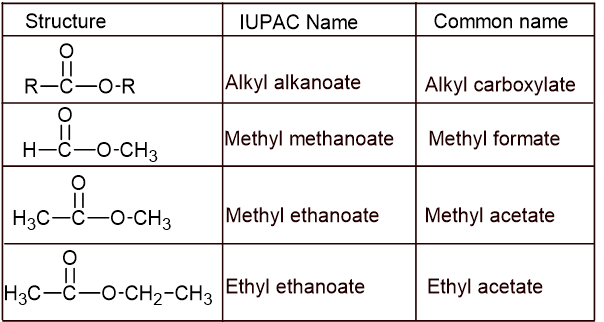


Preparation
1. From carboxylic acid (Esterification)

Physical Properties
- Esters are colourless oily liquids with fruity odour.
- They are sparingly soluble in water.
- The boiling points of esters are always less than corrosponding carboxylic acids.
Chemical properties
1. Hydrolysis
\begin{align*} RCOOR + H_{2}O &\xrightarrow[]{H^{+}}RCOOH + ROH\\ CH_{3}COOCH_{3} + H_{2}O &\xrightarrow[]{H^{+}} CH_{3}COOH + CH_{3}OH \end{align*}2. Reduction
\begin{align*} RCOOR &\xrightarrow[]{LiAlH_{4}}RCH_{2}OH + ROH\\ CH_{3}COOCH_{3} &\xrightarrow[]{LiAlH_{4}} CH_{3}CH_{2}OH + CH_{3}OH \end{align*}3. Ammonolysis
\begin{align*} RCOOR+NH_{3} &\rightarrow RCONH_{2} + ROH\\ CH_{3}COOCH_{3}+NH_{3} &\rightarrow CH_{3}CONH_{2} + CH_{3}OH \end{align*}4. Action with PCl5
5. Claisen condensation: Esters having α -hydrogen reacts with base like sodium ethoxide to form β- keto ester.

D. Acid anhydride


Preparation
1. From carboxylic acid: Acid anhydride is prepared by heating two molecules of the carboxylic acid with a strong dehydrating agent like P2O5 or V2O5.

Physical properties
- Lower members are colourless liquid having sharp irritating smell. Higher members are colourless solids.
- They are generally insoluble in water but soluble in organic solvents.
- They have higher boiling point than parent carboxylic acid.
Chemical properties
1. Hydrolysis

2. Ammonolysis

3. Alcoholysis

4. Reduction

5. Action with PCl5

Relative reactivity of acid derivatives




Questions & discussion
Have a question, or found this note helpful? Be the first to comment.