


Amino acids are organic compounds that carry an amino group (–NH2) and a carboxyl group (–COOH), and proteins are large molecules made of long chains of amino acids joined by peptide bonds. This note covers amino acids and proteins with their structure, classification, functions, diagrams, differences and important exam questions.
1. Amino acids
An amino acid is defined as an organic acid in which an amino group (–NH2) and a carboxyl group (–COOH) are attached to the same carbon atom, called the α-carbon. The α-carbon also carries a hydrogen atom and a side chain called the R group. The R group is different in each amino acid, and it gives each amino acid its own properties.
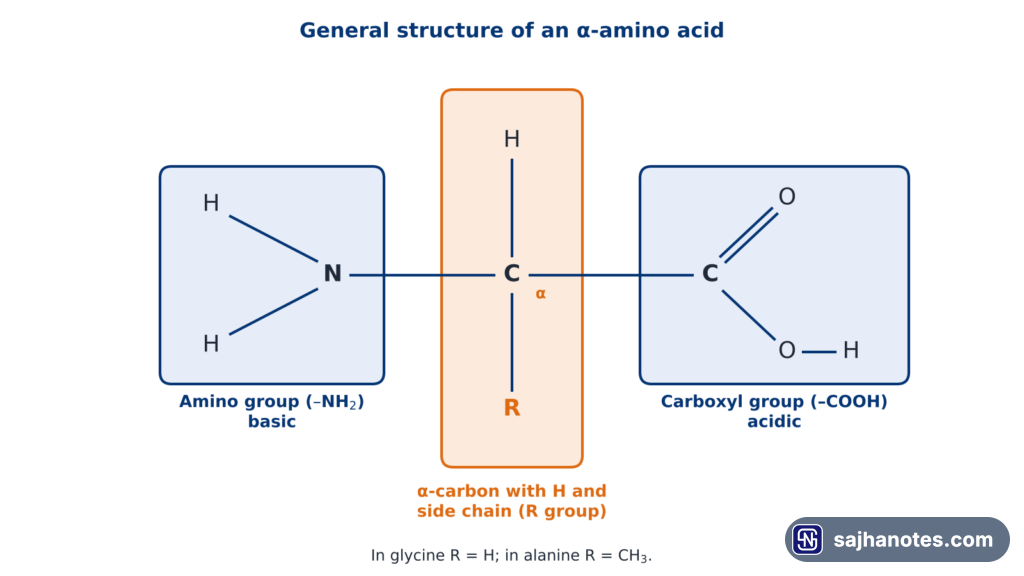
An amino acid has a basic group (–NH2) and an acidic group (–COOH) in the same molecule, so it can behave both as an acid and as a base. Molecules that show both acidic and basic properties are called amphoteric molecules. In water, an amino acid can carry a positive charge on –NH3+ and a negative charge on –COO− at the same time; this form is called a zwitterion.
Amino acids are the building blocks of proteins. Many amino acids join together in a long chain to form a protein.
Characteristics of amino acids
- Every amino acid has at least one acidic carboxyl group (–COOH) and one basic amino group (–NH2).
- They are colourless, crystalline solids.
- They dissolve in water, but they dissolve poorly in organic solvents such as alcohol and ether.
- About 20 different amino acids are commonly used to build proteins, for example alanine, glycine, serine, leucine and isoleucine.
- Glycine is the simplest amino acid because its R group is only a hydrogen atom.
Living things also contain many amino acids that are never used to build proteins. These are called non-protein amino acids, and some of them are used to make antibiotics.
2. Peptide bond
The bond formed between the carboxyl group (–COOH) of one amino acid and the amino group (–NH2) of another amino acid, with the removal of one molecule of water, is called a peptide bond (–CO–NH–). This joining of amino acids is also called a peptide linkage.
The formation of a peptide bond takes place in the following steps:
- Two amino acids come close together so that the –COOH group of the first faces the –NH2 group of the second.
- The –OH from the carboxyl group of the first amino acid and one –H from the amino group of the second amino acid are removed as one molecule of water (H2O).
- The carbon of the first carboxyl group bonds with the nitrogen of the second amino group, and a –CO–NH– link is formed.
- The product made of two amino acids is called a dipeptide. When many amino acids join in this way, a long chain called a polypeptide is formed.
Amino acid + Amino acid → Dipeptide + H2O
H2N–CHR1–COOH + H2N–CHR2–COOH → H2N–CHR1–CO–NH–CHR2–COOH + H2O
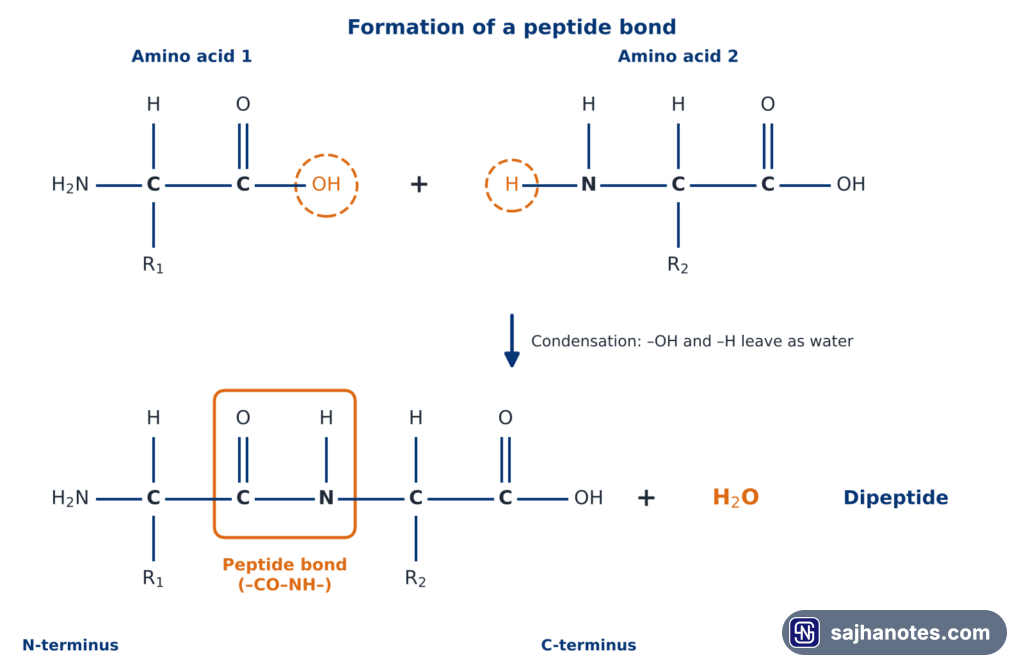
A polypeptide chain has a free amino group at one end, called the N-terminus, and a free carboxyl group at the other end, called the C-terminus.
3. Types and functions of amino acids
On the basis of whether the human body can make them, amino acids are of two main types:
- Essential amino acids: The amino acids that the human body cannot make, and that must therefore be taken in the diet, are called essential amino acids. There are nine of them: histidine, isoleucine, leucine, lysine, methionine, phenylalanine, threonine, tryptophan, and valine.
- Non-essential amino acids: The amino acids that the human body can make from other substances, so that they need not be present in the diet, are called non-essential amino acids. There are eleven of them: alanine, arginine, asparagine, aspartic acid, cysteine, glutamic acid, glutamine, glycine, proline, serine and tyrosine.
Some non-essential amino acids become essential during illness or stress, when the body cannot make enough of them. These are called conditionally essential amino acids. For example, arginine, glycine, proline, serine and tyrosine are conditionally essential. Histidine is listed as essential because many people, especially growing children, cannot make enough of it.
A simple way to remember the nine essential amino acids is the phrase “PVT TIM HaLL”: phenylalanine, valine, tryptophan, threonine, isoleucine, methionine, histidine, leucine and lysine.
Functions of amino acids
- Building blocks: Amino acids join together to form proteins and enzymes.
- Tryptophan: It is used to make the vitamin niacin in animals and the plant hormone indole acetic acid (IAA).
- Tyrosine: It is used to make the animal hormones thyroxine and epinephrine (adrenaline) and the pigment melanin.
- Glycine: It is used to make protoporphyrin, which forms the haem part of haemoglobin.
- Antibiotics: Several non-protein amino acids are used in the synthesis of antibiotics.
- Cell wall: In prokaryotes, short peptides combine with carbohydrates to form peptidoglycan, which makes up the bacterial cell wall.
4. Proteins
Proteins are defined as complex organic macromolecules made of one or more long chains of amino acids joined by peptide bonds. The name comes from the Greek word proteios, which means “of the first rank”, because proteins are among the most important substances in living things.
- Proteins show the greatest variety of structure among the macromolecules, and they make up more than 50% of the dry weight of a cell.
- About 20 kinds of amino acids, joined in different numbers and orders, form all the different proteins.
- The order of amino acids in each protein is fixed by a gene, that is, by the sequence of bases in DNA.
- Enzymes are proteins, and they control almost all the chemical reactions of the body.
5. Classification of proteins
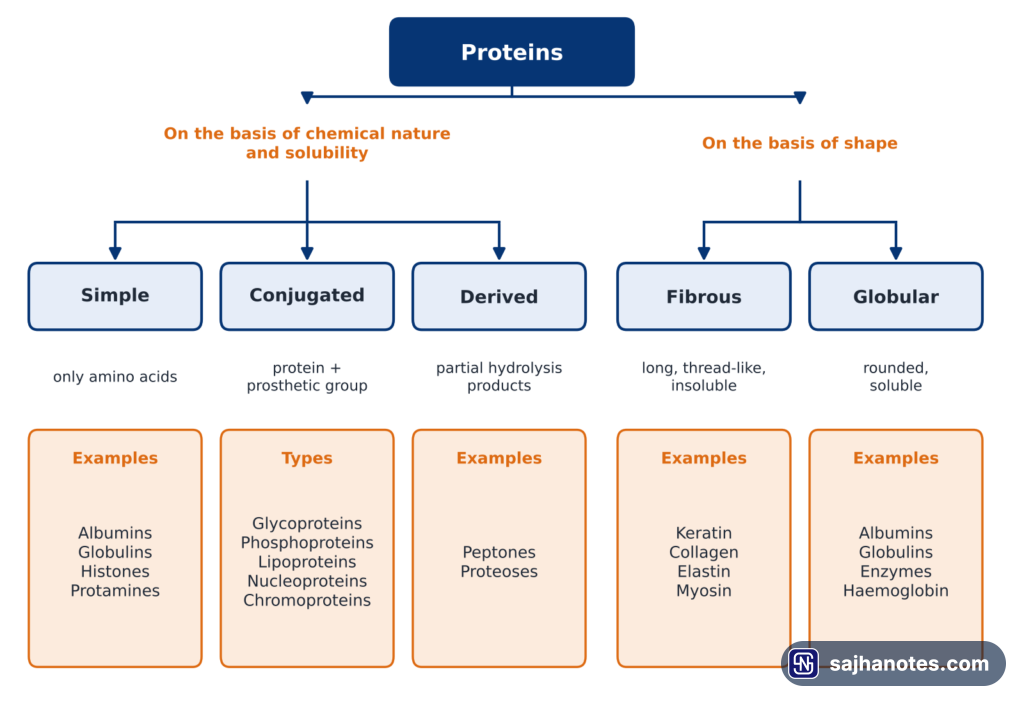
Based on chemical nature and solubility
- Simple proteins: These proteins give only amino acids when they are hydrolysed. For example, albumins, globulins, histones and protamines are simple proteins.
- Conjugated proteins: These proteins are made of a simple protein joined to a non-protein part. The non-protein part is called the prosthetic group.
- Derived proteins: These proteins are obtained when simple or conjugated proteins are partly broken down by hydrolysis. For example, peptones and proteoses are derived proteins.
Conjugated proteins are named after their prosthetic group:
| Type | Prosthetic group | Example |
|---|---|---|
| Glycoprotein | Carbohydrate | Mucin of saliva |
| Phosphoprotein | Phosphoric acid (phosphate) | Casein of milk, ovovitellin of egg yolk |
| Lipoprotein | Lipid | High density lipoprotein (HDL) and low density lipoprotein (LDL) of blood |
| Nucleoprotein | Nucleic acid | Nucleohistone of chromosomes (DNA + histone) |
| Chromoprotein | Coloured pigment, often containing a metal such as Fe, Cu, Mg or Co | Haemoglobin of blood, rhodopsin of the retina |
Some books state that glycoproteins are formed from protein and glucose. The correct fact is that the prosthetic group of a glycoprotein is a carbohydrate, usually a short chain of several sugars.
Some books give histone as an example of a nucleoprotein. The correct fact is that histone is a simple protein; it becomes a nucleoprotein (nucleohistone) only when it is joined to DNA in the chromosome.
Based on shape
- Fibrous proteins: These proteins have long, thread-like polypeptide chains that are twisted together into fibres. They are strong, often elastic and insoluble in water, and they are found mostly in animals. For example, keratin of hair, collagen of tendons, elastin and myosin of muscle are fibrous proteins.
- Globular proteins: These proteins have polypeptide chains folded into a compact, rounded shape. They are usually soluble in water. For example, egg albumin, serum albumin, globulins, glutelins, enzymes and haemoglobin are globular proteins.
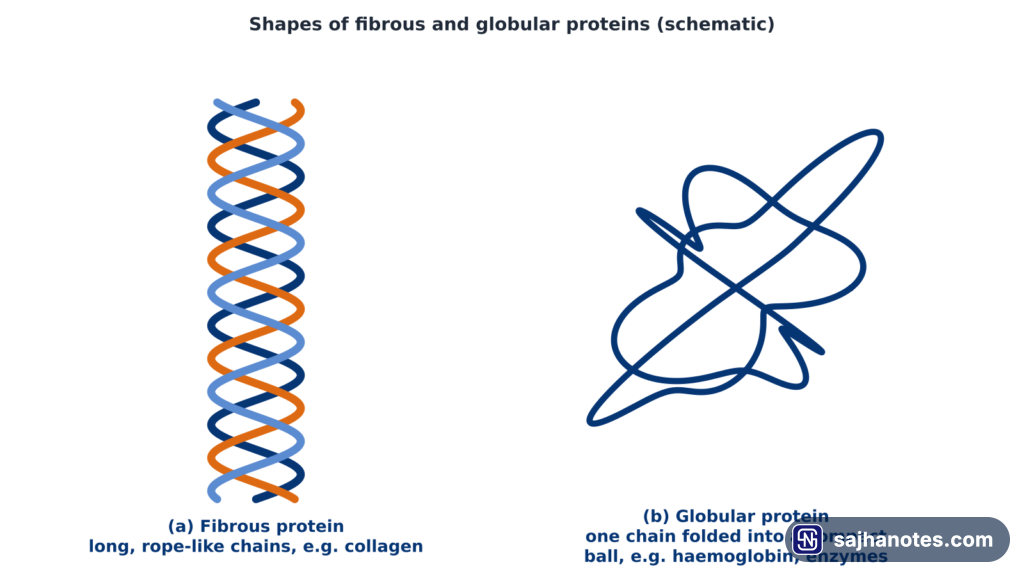
Globular proteins, such as enzymes and antibodies, are found in all living organisms, while fibrous proteins are found mostly, but not only, in animals.
6. Structure of proteins
Proteins are polymers of many amino acids. A polypeptide chain folds in a definite way, and its shape can be described at four levels: primary, secondary, tertiary and quaternary structure.
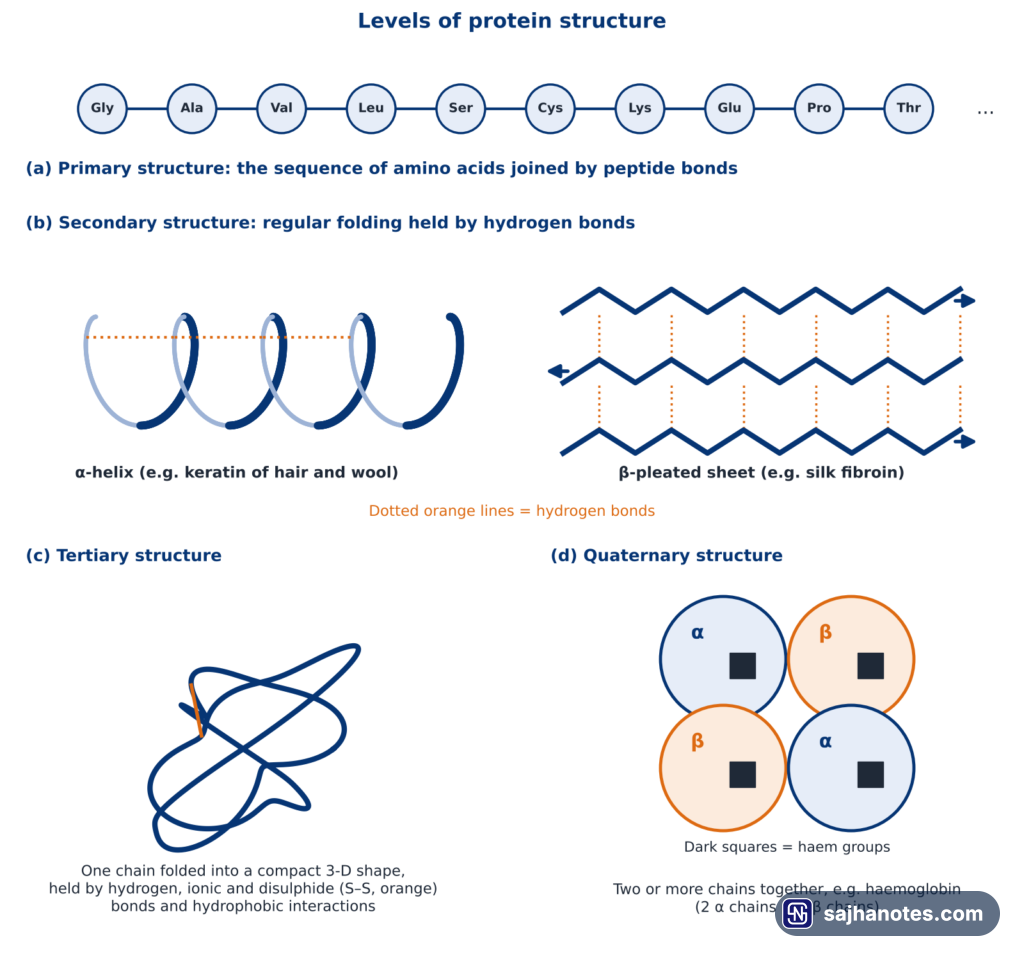
- Primary structure: The linear sequence of amino acids in a polypeptide chain is called the primary structure of a protein. Only peptide bonds hold the chain at this level. Every protein has a primary structure, and it decides all the higher levels of folding. Insulin was the first protein whose primary structure (51 amino acids in two chains) was worked out.
- Secondary structure: The regular, repeated folding of a polypeptide chain into a helix or a sheet is called the secondary structure. It is held by hydrogen bonds between the C=O group of one peptide bond and the N–H group of another. In the α-helix, the chain coils like a spring, for example in keratin of hair and wool. In the β-pleated sheet, neighbouring stretches of chain lie side by side, for example in silk fibroin.
- Tertiary structure: The folding of the whole polypeptide chain, including its helices and sheets, into a compact three-dimensional shape is called the tertiary structure. This shape is held by hydrogen bonds, ionic bonds, disulphide bonds (–S–S–) and hydrophobic interactions. It is typical of globular proteins, for example myoglobin and most enzymes.
- Quaternary structure: The arrangement of two or more polypeptide chains (subunits) into one functional protein is called the quaternary structure. The chains are held together by the same kinds of bonds as in tertiary structure. For example, haemoglobin has four chains (two α and two β), and immunoglobulins have four chains (two heavy and two light).
Every protein has a primary structure; insulin is known as the first protein whose amino acid sequence was found, by Frederick Sanger.
Ribonuclease is made of a single polypeptide chain, so it has only up to tertiary structure. Haemoglobin and immunoglobulins are the correct examples.
Importance of amino acid sequence
The sequence of amino acids in a protein is decided by the DNA of its gene. If the DNA changes, the amino acid sequence changes, and this can change both the shape and the function of the protein.
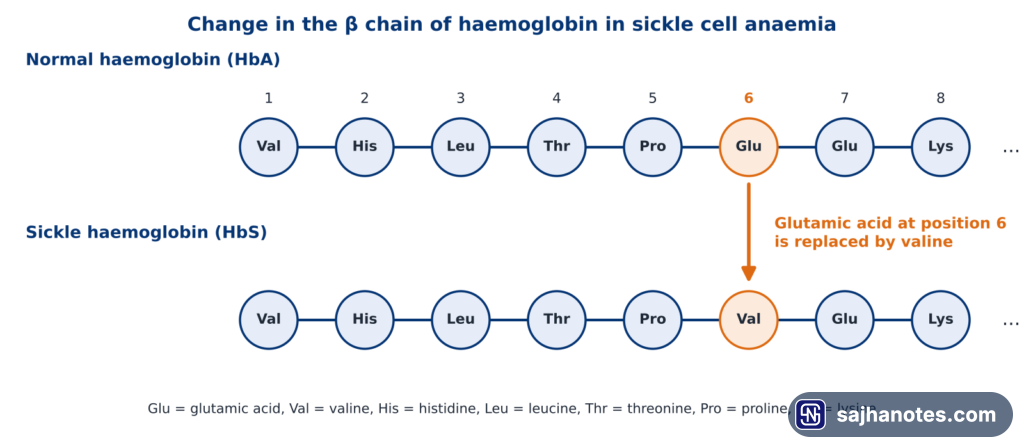
For example, in sickle cell anaemia, the sixth amino acid of the β chain of haemoglobin is valine instead of glutamic acid. This single change makes the haemoglobin molecules stick together when oxygen is low, and the red blood cells become sickle-shaped.
Denaturation of proteins
The loss of the natural three-dimensional shape of a protein, due to heat, a change in pH or certain chemicals, is called denaturation. The bonds that hold the secondary, tertiary and quaternary structure break, but the peptide bonds of the primary structure usually remain. A denatured protein usually loses its function.
For example, egg white is clear because its albumin molecules are folded into a definite shape. When the egg is boiled, heat breaks the bonds that hold this shape. The unfolded chains expose their hydrophobic amino acids, stick to one another and form a solid white network.
7. Functions of proteins
- Structural role: Proteins build and repair body tissues and support growth. For example, keratin forms hair and nails, and collagen forms tendons and skin.
- Source of energy: Proteins can be used for energy. One gram of protein gives 5.65 kcal of energy when burnt completely, and its physiological fuel value in the body is 4.0 kcal per gram.
- Enzymes: All enzymes are proteins. Thousands of different enzymes act as biocatalysts and control the chemical reactions of life.
- Hormones: Some hormones are proteins. For example, insulin controls the level of glucose in the blood.
- Defence: Antibodies, also called immunoglobulins, are proteins that protect the body against foreign substances and microorganisms.
- Blood clotting: Thrombin and fibrinogen are proteins that stop bleeding. At a wound, the enzyme thrombin changes the soluble plasma protein fibrinogen into insoluble threads of fibrin, which form a mesh that traps blood cells and makes a clot.
- Transport: Some proteins carry substances. For example, haemoglobin carries oxygen in the blood.
8. Differences at a glance
Essential and non-essential amino acids
| Basis | Essential amino acids | Non-essential amino acids |
|---|---|---|
| Synthesis in the body | The human body cannot make them. | The human body can make them. |
| Need in the diet | They must be taken in food. | They need not be taken in food. |
| Number | There are nine of them. | There are eleven of them. |
| Examples | Lysine, leucine, valine and tryptophan | Alanine, glycine, serine and glutamic acid |
Fibrous and globular proteins
| Basis | Fibrous proteins | Globular proteins |
|---|---|---|
| Shape | They are long and thread-like. | They are compact and rounded. |
| Solubility | They are insoluble in water. | They are usually soluble in water. |
| Main role | They have mostly structural roles. | They have mostly functional roles, such as catalysis and transport. |
| Occurrence | They are found mostly in animals. | They are found in all living organisms. |
| Examples | Keratin, collagen, elastin and myosin | Albumin, globulins, enzymes and haemoglobin |
Simple and conjugated proteins
| Basis | Simple proteins | Conjugated proteins |
|---|---|---|
| Composition | They are made of amino acids only. | They are made of a protein joined to a prosthetic group. |
| Products of hydrolysis | They give only amino acids. | They give amino acids and the non-protein part. |
| Examples | Albumins, globulins and histones | Haemoglobin, casein and mucin |
Primary and quaternary structure
| Basis | Primary structure | Quaternary structure |
|---|---|---|
| Meaning | It is the sequence of amino acids in one polypeptide chain. | It is the arrangement of two or more polypeptide chains in one protein. |
| Bonds | Only peptide bonds are involved. | Hydrogen, ionic and disulphide bonds and hydrophobic interactions hold the chains together. |
| Occurrence | Every protein has it. | Only proteins with more than one chain have it. |
| Examples | Insulin and every other protein | Haemoglobin and immunoglobulins |
9. Important questions
Short answer questions
Q1. What is an amino acid? Why are amino acids called amphoteric molecules?
An amino acid is an organic acid in which an amino group (–NH2) and a carboxyl group (–COOH) are attached to the same α-carbon, which also carries a hydrogen atom and an R group. Amino acids are called amphoteric because they have both a basic amino group and an acidic carboxyl group, so they can act both as acids and as bases.
Q2. What is a peptide bond? How is it formed?
A peptide bond (–CO–NH–) is the bond that joins two amino acids. It is formed when the carboxyl group of one amino acid reacts with the amino group of another amino acid, and one molecule of water is removed. Two amino acids joined in this way form a dipeptide.
Q3. Distinguish between essential and non-essential amino acids.
| Basis | Essential amino acids | Non-essential amino acids |
|---|---|---|
| Synthesis | The body cannot make them. | The body can make them. |
| Diet | They must be taken in food. | They need not be taken in food. |
| Number | There are nine of them. | There are eleven of them. |
| Examples | Lysine, leucine and tryptophan | Alanine, glycine and serine |
Q4. Which amino acid is the precursor of the plant hormone indole acetic acid (IAA)?
Tryptophan is the precursor of the plant hormone indole acetic acid (IAA). Tryptophan is also used to make the vitamin niacin.
Q5. Name one fibrous protein and one globular protein.
Keratin, which forms hair and nails, is a fibrous protein. Haemoglobin, which carries oxygen in the blood, is a globular protein.
Q6. What is a prosthetic group? Give one example.
A prosthetic group is the non-protein part that is joined to a simple protein in a conjugated protein. For example, the haem group of haemoglobin is a prosthetic group.
Q7. What is the role of antibodies in the body?
Antibodies, or immunoglobulins, are proteins made by the body that recognise and bind to foreign substances and microorganisms. In this way they protect the body against infection and give it immunity.
Q8. What is denaturation of proteins? Give an example.
Denaturation is the loss of the natural three-dimensional shape of a protein due to heat, a change in pH or chemicals, and it usually makes the protein lose its function. For example, the clear albumin of egg white becomes solid and white when the egg is boiled.
Q9. Explain the function of thrombin and fibrinogen in preventing bleeding.
Fibrinogen is a soluble protein present in blood plasma, and thrombin is an enzyme formed at the site of a wound. Thrombin changes fibrinogen into insoluble fibrin threads. These threads form a mesh over the wound that traps blood cells and forms a clot, which stops the bleeding.
Q10. What is the cause of sickle cell anaemia at the protein level?
In sickle cell anaemia, the sixth amino acid of the β chain of haemoglobin is valine instead of glutamic acid. This change in the primary structure, caused by a change in the gene, makes the red blood cells sickle-shaped when oxygen is low.
Q11. Describe the primary structure of a protein and its significance in protein function.
The primary structure of a protein is the linear sequence of amino acids in its polypeptide chain, joined only by peptide bonds. It is fixed by the base sequence of the gene. The primary structure decides where the chain forms helices and sheets and how it folds into its final shape, so it decides the function of the protein. A change of even one amino acid can change the function, as in sickle cell anaemia, where valine replaces glutamic acid in the β chain of haemoglobin.
Q12. Identify the type of protein structure in which several stretches of a polypeptide chain lie side by side and are joined by hydrogen bonds.
This is the secondary structure of a protein in the form of a β-pleated sheet. The neighbouring stretches of the chain are held together by hydrogen bonds between C=O and N–H groups.
Q13. In the general structure of an amino acid, identify the parts x (–NH2), y (the carbon carrying H and R) and z (–COOH).
Part x is the amino group (–NH2), which is basic. Part y is the α-carbon with its hydrogen atom and R side chain. Part z is the carboxyl group (–COOH), which is acidic.
Long answer questions
Q14. Describe the structure of proteins with suitable diagrams.
Proteins are polymers of amino acids joined by peptide bonds. The structure of a protein is described at four levels:
- Primary structure: It is the linear sequence of amino acids in a polypeptide chain, held only by peptide bonds. It is fixed by the gene and decides how the chain will fold. For example, insulin was the first protein whose sequence was worked out.
- Secondary structure: It is the regular folding of the chain held by hydrogen bonds between C=O and N–H groups. It may be an α-helix, as in keratin, or a β-pleated sheet, as in silk fibroin.
- Tertiary structure: It is the further folding of the chain into a compact three-dimensional shape held by hydrogen, ionic and disulphide bonds and hydrophobic interactions, as in myoglobin and enzymes.
- Quaternary structure: It is the arrangement of two or more polypeptide chains into one protein, as in haemoglobin, which has two α and two β chains.
(Draw the four levels of protein structure.) The correct shape of a protein is needed for its function, and a change in the amino acid sequence, as in sickle cell anaemia, can change its shape and function.
Q15. Classify proteins on the basis of chemical nature with examples.
On the basis of chemical nature and solubility, proteins are classified into three groups:
- Simple proteins: They give only amino acids on hydrolysis, for example albumins, globulins, histones and protamines.
- Conjugated proteins: They are made of a simple protein joined to a prosthetic group. They are glycoproteins (carbohydrate, e.g. mucin), phosphoproteins (phosphate, e.g. casein), lipoproteins (lipid, e.g. HDL), nucleoproteins (nucleic acid, e.g. nucleohistone) and chromoproteins (coloured pigment, e.g. haemoglobin).
- Derived proteins: They are formed by the partial hydrolysis of other proteins, for example peptones and proteoses.
On the basis of shape, proteins are also classified as fibrous proteins, such as keratin, and globular proteins, such as haemoglobin. (Draw the classification chart of proteins.)
Q16. Explain the difference between primary and quaternary protein structures, giving examples of proteins that show each.
| Basis | Primary structure | Quaternary structure |
|---|---|---|
| Meaning | It is the sequence of amino acids in one polypeptide chain. | It is the arrangement of two or more polypeptide chains in one protein. |
| Bonds | Only peptide bonds are involved. | Hydrogen, ionic and disulphide bonds and hydrophobic interactions hold the chains together. |
| Occurrence | Every protein has it. | Only proteins with more than one chain have it. |
| Examples | Insulin and every other protein | Haemoglobin and immunoglobulins |
The primary structure decides how the chain folds, so it also decides whether and how chains come together in the quaternary structure.
Q17. Describe the functions of proteins.
Proteins are large molecules made of amino acids, and they perform the following functions:
- Structure: They build and repair tissues, for example keratin in hair and collagen in tendons.
- Energy: They give 5.65 kcal per gram on complete burning, with a physiological fuel value of 4.0 kcal per gram.
- Enzymes: All enzymes are proteins that act as biocatalysts.
- Hormones: Insulin is a protein hormone that controls blood glucose.
- Defence: Antibodies (immunoglobulins) protect the body against foreign substances.
- Blood clotting: Thrombin changes fibrinogen into fibrin to form a clot.
- Transport: Haemoglobin carries oxygen in the blood.
Thus proteins are needed for the structure, control and defence of the body.
10. Practice MCQs
Practice: Amino acids and proteins
Show answer
Answer: B An amino group, a carboxyl group, a hydrogen atom and an R group
Show answer
Answer: C Glycine
Show answer
Answer: A Water
Show answer
Answer: D Lysine
Show answer
Answer: B Thyroxine
Show answer
Answer: A Phosphoprotein
Show answer
Answer: D Primary
Show answer
Answer: C α-helix
Show answer
Answer: A Haemoglobin
Show answer
Answer: B Valine



Questions & discussion
Have a question, or found this note helpful? Be the first to comment.