


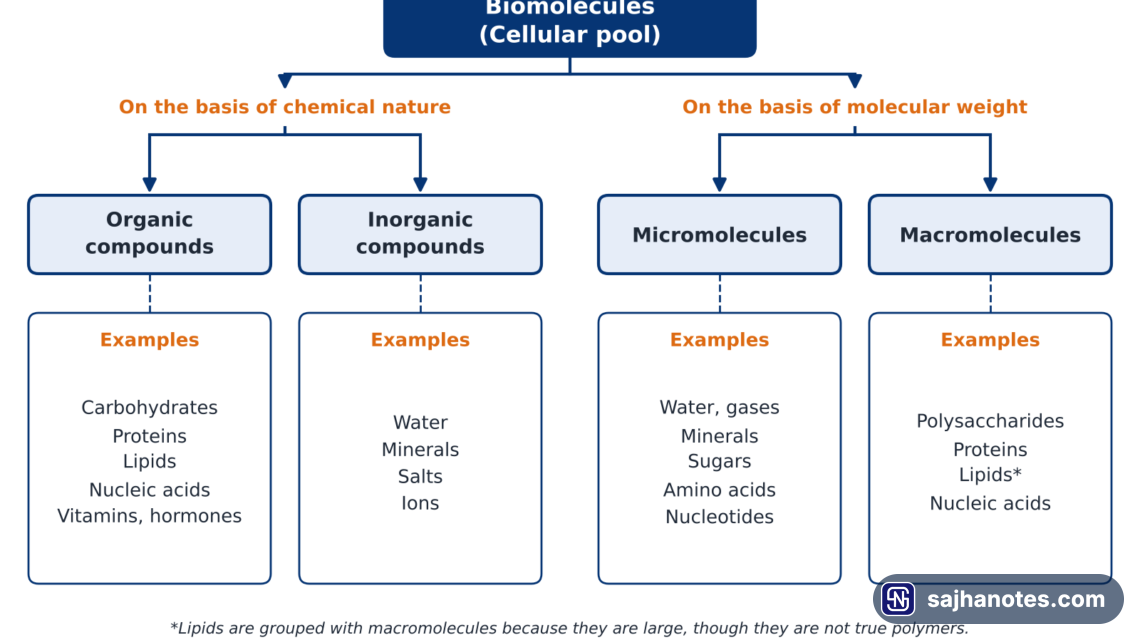
The organic and inorganic molecules that make up the cells and bodies of living organisms are called biomolecules. This note covers the introduction to biomolecules and carbohydrates for the NEB Grade 11 Biology syllabus, with their classification, structures, functions, diagrams, differences and important exam questions.
1. Biomolecules and the cellular pool
All living things, from bacteria to large plants and animals, are built from the same kinds of molecules. These molecules range from very small ones such as water and carbon dioxide to very large ones such as proteins and nucleic acids.
- Biomolecules: The chemical compounds found in living cells and organisms are called biomolecules.
- Metabolism: The sum of all the chemical reactions that take place in a living cell is called metabolism. Small biomolecules dissolve easily and move freely inside the cell, so they take part in most metabolic reactions.
- Cellular pool: The total collection of biomolecules present in a cell is called the cellular pool. These chemicals enter the cell from its surroundings by passing across the plasma membrane and the membranes of the organelles.
Living cells are made mainly of six elements: carbon (C), hydrogen (H), nitrogen (N), oxygen (O), phosphorus (P) and sulphur (S). Together these make up about 99% of the mass of a cell. The remaining 1% is made of elements such as calcium, iron, zinc, sodium, potassium and chlorine. Water alone forms 70–90% of the mass of a cell.
Organic and inorganic compounds
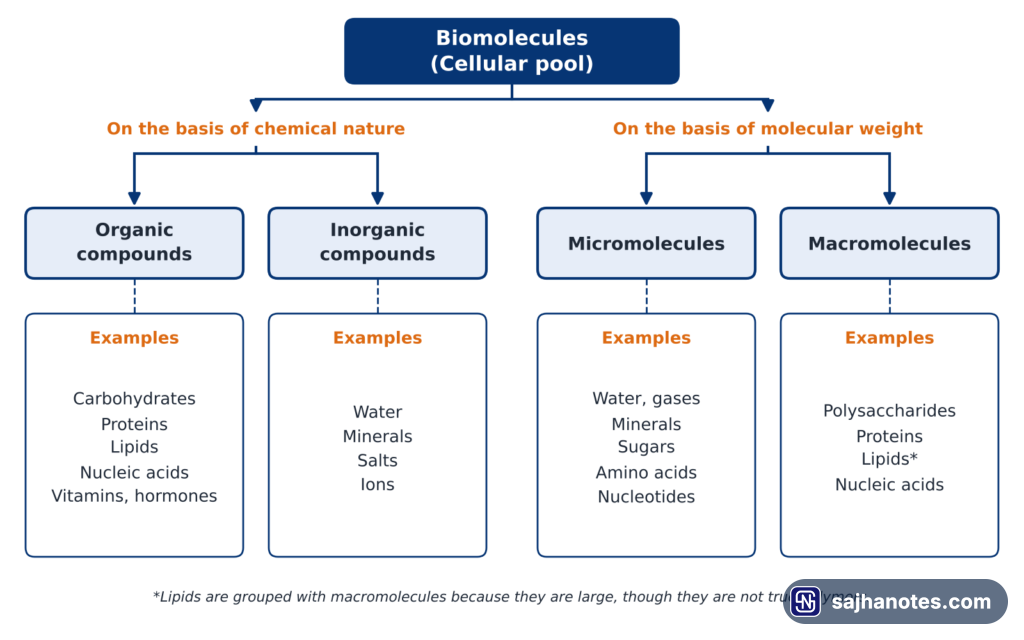
On the basis of their chemical nature, the biomolecules of the cellular pool are of two types:
- Organic compounds: These are compounds made mainly of carbon combined with other elements such as hydrogen, oxygen, nitrogen and sulphur. For example, carbohydrates, proteins, lipids, nucleic acids, hormones and vitamins are organic compounds.
- Inorganic compounds: These are substances that do not have a carbon framework and are also common in the non-living world. For example, water, mineral salts and ions such as Na+, K+ and Cl− are inorganic substances of the cell.
Micromolecules and macromolecules
On the basis of molecular weight and solubility, biomolecules are of two types:
- Micromolecules: Biomolecules that are small in size and have a low molecular weight are called micromolecules. For example, water, gases, minerals, sugars, amino acids and nucleotides are micromolecules. They are usually soluble in water.
- Macromolecules: Biomolecules that are large, structurally complex and have a high molecular weight are called macromolecules. They are of four classes: carbohydrates (polysaccharides), proteins, lipids and nucleic acids. Lipids are placed in this group because they are large molecules, although they are not polymers of repeating units.
Large molecules are used mostly for building the structure of the cell. Some of them are informational molecules: DNA and RNA carry genetic information, and proteins express that information.
Chemical composition of a cell
The table below shows the approximate share of each component in the mass of a cell.
| Component | Percentage of cell mass |
|---|---|
| Water | 70–90% |
| Proteins | 10–15% |
| Nucleic acids | 5–7% |
| Carbohydrates | 3% |
| Lipids | 2% |
| Ions (inorganic) | 1% |
Water is the most abundant compound in a cell, and proteins are the most abundant organic compounds. Proteins form more than half of the dry weight of a cell.
2. Carbohydrates
Carbohydrates are defined as the biomolecules made of carbon, hydrogen and oxygen in which hydrogen and oxygen are usually present in the ratio 2:1, as in water. The name comes from the Latin word carbo (carbon) and the Greek word hydro (water), so carbohydrates are also called hydrates of carbon.
General formula of carbohydrates: Cx(H2O)y
For example, glucose: C6H12O6 = C6(H2O)6
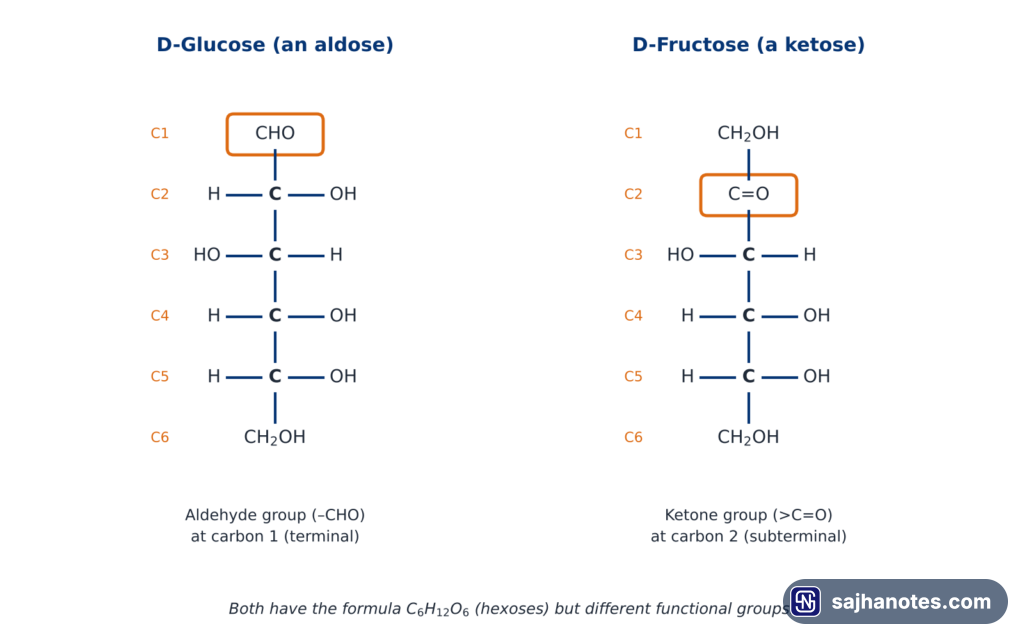
Chemically, carbohydrates are aldehyde or ketone derivatives of polyhydroxy alcohols. This means that a carbohydrate molecule carries several hydroxyl (–OH) groups along with either an aldehyde group or a ketone group.
- Aldoses: Carbohydrates that contain an aldehyde group (–CHO) at the terminal carbon atom are called aldoses. For example, glucose and galactose are aldoses.
- Ketoses: Carbohydrates that contain a ketone group (>C=O) at a subterminal carbon atom (usually carbon 2) are called ketoses. For example, fructose is a ketose.
Carbohydrates are the main source of energy for all living organisms. They are also called saccharides, from the Greek word sakcharon meaning sugar.
The formula Cx(H2O)y is only a general guide. Acetic acid (C2H4O2) fits the formula but is not a carbohydrate, while deoxyribose (C5H10O4) is a carbohydrate even though it does not fit the formula.
3. Classification of carbohydrates
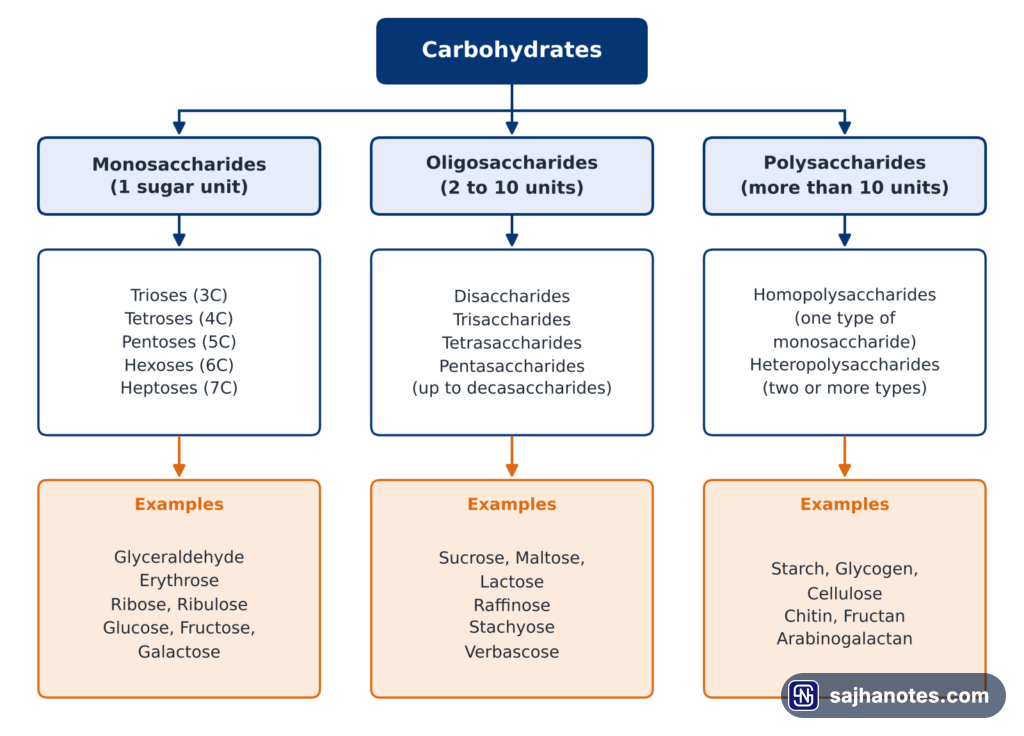
On the basis of their chemical complexity, that is, the number of sugar units they contain, carbohydrates are classified into three groups:
- Monosaccharides (monomers), which have a single sugar unit.
- Oligosaccharides (oligomers), which have 2 to 10 sugar units.
- Polysaccharides (polymers), which have more than 10 sugar units.
Monosaccharides
Monosaccharides are defined as the simplest carbohydrates, which cannot be hydrolysed (broken down) into smaller sugar units. Their general formula is CnH2nOn, where n is a whole number from 3 to 7. For example, glucose, fructose and galactose are monosaccharides.
The main characteristics of monosaccharides are given below:
- They are the simplest sugars and act as the building blocks (monomers) of all other carbohydrates.
- They are polyhydroxy compounds in which every carbon atom except one carries a hydroxyl group. The remaining carbon carries an aldehyde or a ketone group.
- They are white, crystalline solids that are sweet in taste and highly soluble in water.
- They have a free aldehyde or ketone group, so they can reduce cupric ions (Cu2+) to cuprous ions (Cu+). For this reason they are called reducing sugars.
On the basis of the number of carbon atoms and the functional group, monosaccharides are classified as follows:
| Type (formula) | Aldose | Ketose |
|---|---|---|
| Triose (C3H6O3) | Glyceraldehyde | Dihydroxyacetone |
| Tetrose (C4H8O4) | Erythrose | Erythrulose |
| Pentose (C5H10O5) | Ribose | Ribulose |
| Hexose (C6H12O6) | Glucose | Fructose |
| Heptose (C7H14O7) | Glucoheptose | Sedoheptulose |
Glucose (C6H12O6) is an aldohexose, which means it is a six-carbon sugar with an aldehyde group. Its open chain carries five hydroxyl groups and one aldehyde group. Glucose is the most abundant monosaccharide in nature. It forms white crystals, tastes sweet and dissolves easily in water. Fructose is a ketohexose found in fruits and honey, and galactose is an aldohexose that forms part of milk sugar.
In water, pentoses and hexoses exist mostly as ring structures rather than open chains. Glucose usually forms a six-membered ring called a pyranose ring. Fructose, as it occurs in sucrose, and ribose, as it occurs in nucleic acids, form five-membered rings called furanose rings.
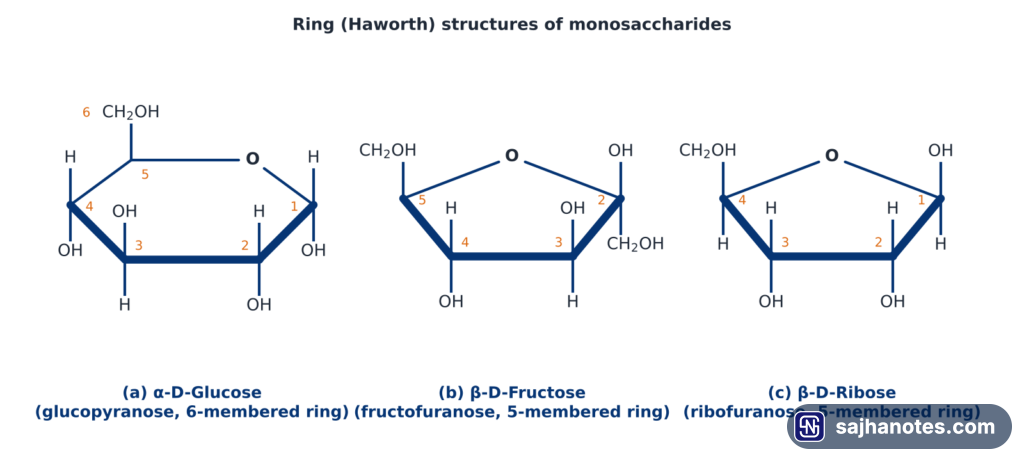
The pentose sugars ribose and deoxyribose are structural parts of the nucleic acids. Ribose is found in RNA, and deoxyribose is found in DNA.
Derived monosaccharides are defined as the compounds formed when a functional group of a monosaccharide is added, removed or changed. Their main types are given below:
- Deoxy sugars: A hydroxyl group is replaced by a hydrogen atom, so the sugar has one oxygen atom less. For example, deoxyribose of DNA is a deoxy sugar.
- Amino sugars: A hydroxyl group is replaced by an amino group (–NH2). For example, glucosamine is an amino sugar. When an acetyl group is added to glucosamine, N-acetylglucosamine is formed, which is the unit of chitin.
- Sugar acids: A carbon atom of the sugar is oxidised to an acid group. For example, ascorbic acid (vitamin C) is a sugar acid.
- Sugar alcohols: The aldehyde or ketone group is reduced to an alcohol group. For example, mannitol is a sugar alcohol.
Some books state that N-acetylglucosamine is formed when an acetyl group is added to glucose. The correct fact is that it is formed from glucosamine, the amino sugar of glucose, so N-acetylglucosamine contains nitrogen.
Oligosaccharides
Oligosaccharides (Greek oligo = a few) are defined as carbohydrates made of 2 to 10 monosaccharide units joined together by glycosidic bonds. Most of them taste sweet and dissolve in water.
The bond that joins two monosaccharide units is called a glycosidic bond. It is formed between the –OH group on the carbon that carries the aldehyde or ketone group of one sugar (carbon 1 in glucose) and an –OH group of another sugar. One molecule of water is removed during its formation. This type of reaction is called a condensation (dehydration) reaction. When the bond is hydrolysed, the water molecule is added back and the monosaccharides are released.
C6H12O6 + C6H12O6 → C12H22O11 + H2O
Glucose + Glucose → Maltose + Water
Oligosaccharides are named according to the number of monosaccharide units they contain:
| Number of units | Type | Examples |
|---|---|---|
| 2 | Disaccharide | Sucrose (glucose + fructose), maltose (glucose + glucose), lactose (galactose + glucose) |
| 3 | Trisaccharide | Raffinose (galactose + glucose + fructose), mannotriose |
| 4 | Tetrasaccharide | Stachyose (2 galactose + glucose + fructose) |
| 5 | Pentasaccharide | Verbascose |
The disaccharides are the most abundant oligosaccharides in plant and animal cells. The three common disaccharides are described below:
- Sucrose (cane sugar): It is made of one glucose and one fructose joined by an α-1, β-2 glycosidic bond. It is the common table sugar obtained from sugarcane and sugar beet, and it is the form in which sugar is transported in the phloem of plants.
- Maltose (malt sugar): It is made of two glucose units joined by an α-1,4 glycosidic bond. It is formed when starch is digested, for example in germinating seeds.
- Lactose (milk sugar): It is made of one galactose and one glucose joined by a β-1,4 glycosidic bond. It is found in the milk of mammals.
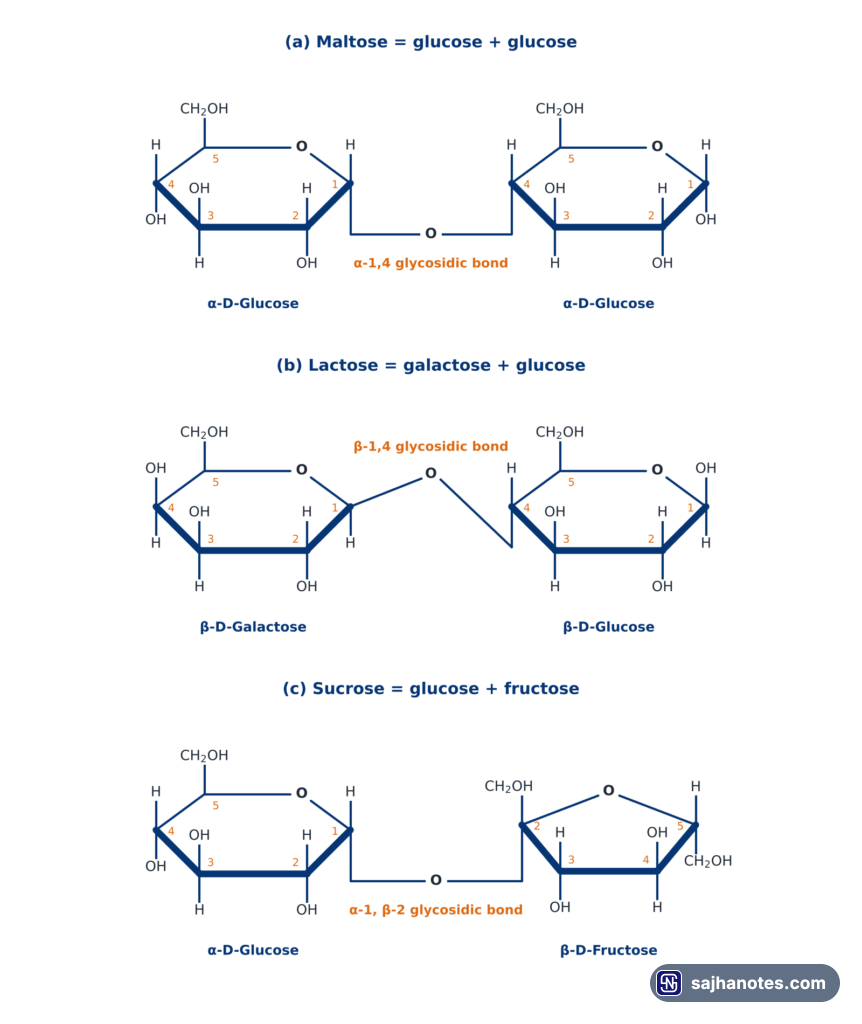
Reducing sugars are not only monosaccharides. Maltose and lactose are also reducing sugars because one of their units still has a free aldehyde group. Sucrose is a non-reducing sugar because its glycosidic bond joins carbon 1 of glucose with carbon 2 of fructose, which are the reducing groups of both sugars.
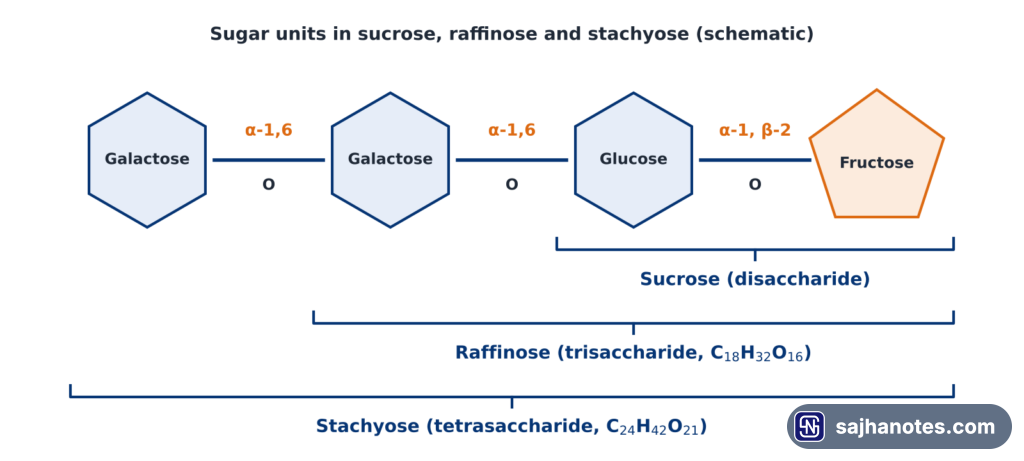
Raffinose (C18H32O16) is a trisaccharide made of galactose, glucose and fructose. It stores food in seeds and legumes, and this food is used by the embryo when the seed germinates. Stachyose (C24H42O21) is a tetrasaccharide made of two galactose units, one glucose and one fructose. Both can be seen as sucrose with extra galactose units attached.
Polysaccharides
Polysaccharides are defined as complex carbohydrates made of more than ten (usually hundreds to thousands of) monosaccharide units joined by glycosidic bonds. They are also called glycans. For example, starch, glycogen, cellulose and dextrin are polysaccharides.
The main characteristics of polysaccharides are given below:
- They have a very high molecular weight and a long, straight or branched chain.
- They are not sweet in taste.
- They are insoluble in water or form only colloidal solutions.
- They are non-reducing, because the reducing groups of almost all their units are used up in glycosidic bonds. Only one end of a long chain has a free reducing group, which has almost no effect.
On the basis of their function, polysaccharides are of two types:
- Structural polysaccharides: These polysaccharides build the structure of cells and organisms. For example, cellulose forms the plant cell wall, chitin forms the fungal cell wall, mannan forms the yeast cell wall and peptidoglycan forms the bacterial cell wall.
- Nutrient (storage) polysaccharides: These polysaccharides store food. For example, starch is the storage food of plants, and glycogen is the storage food of animals.
On the basis of their composition, polysaccharides are of two types:
- Homopolysaccharides (homoglycans): These polysaccharides are built from a single kind of monosaccharide. For example, glucans such as starch, glycogen and cellulose are made of glucose, and fructans such as inulin are made of fructose.
- Heteropolysaccharides (heteroglycans): These polysaccharides are built from two or more kinds of monosaccharides. For example, arabinogalactans are made of arabinose and galactose.
The common polysaccharides are described below:
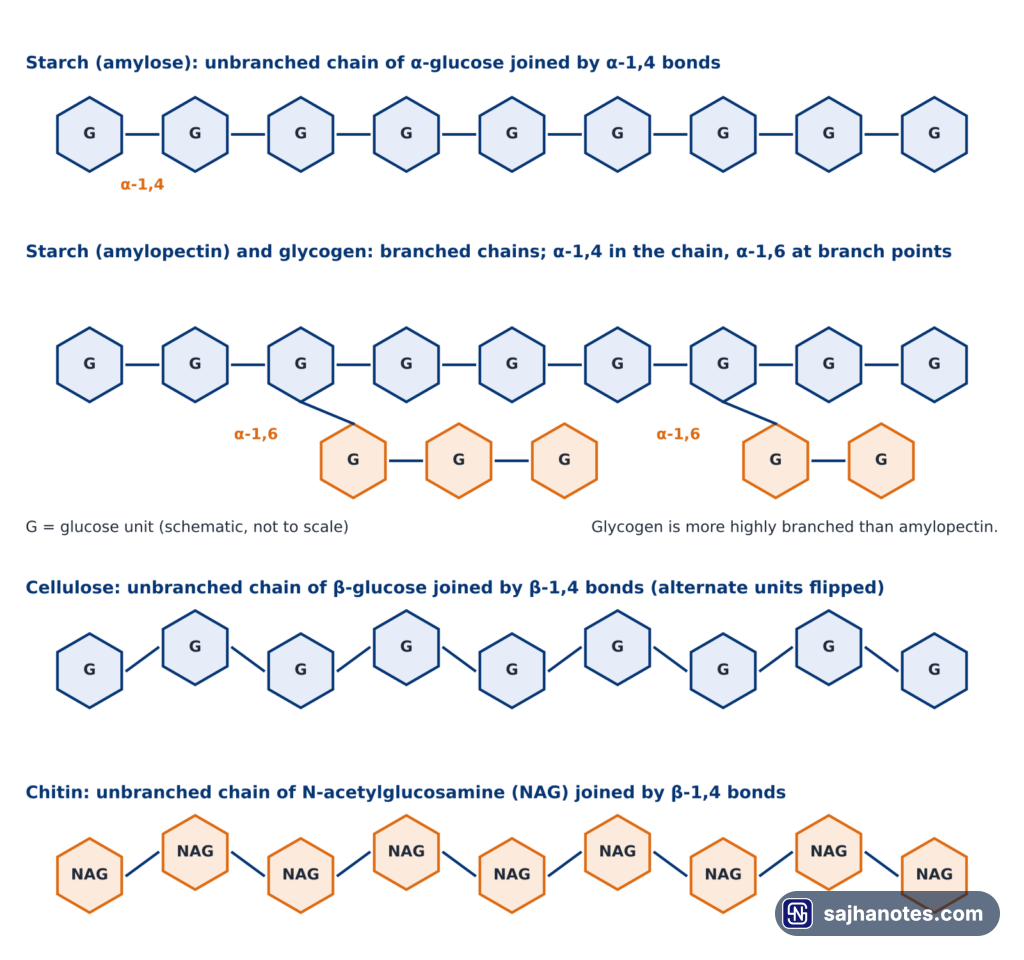
- Starch: It is the storage polysaccharide of plants, found in potato, rice, wheat and maize. It is made of α-glucose units and has two parts: amylose, which is an unbranched chain with α-1,4 bonds, and amylopectin, which is a branched chain with α-1,6 bonds at the branch points.
- Glycogen: It is the storage polysaccharide of animals and fungi, stored mainly in the liver and muscles. It is made of α-glucose units and is more highly branched than amylopectin. It is called animal starch because it stores food in animals in the same way that starch stores food in plants.
- Cellulose: It is the main structural polysaccharide of the plant cell wall and the most abundant organic compound on Earth. It is an unbranched chain of β-glucose units joined by β-1,4 bonds.
- Chitin: It is a structural polysaccharide made of N-acetylglucosamine units joined by β-1,4 bonds. It forms the cell wall of fungi and the exoskeleton of insects and other arthropods.
4. Functions of carbohydrates
Carbohydrates perform the following functions in living organisms:
- Source of energy: Carbohydrates are the main source of energy. They supply about half of the energy we use each day. Glucose is oxidised during cellular respiration to release energy, which is stored as ATP.
- Structural role: The monosaccharides ribose and deoxyribose are structural parts of RNA and DNA. The polysaccharides cellulose and hemicellulose form the plant cell wall, and chitin forms the fungal cell wall and the exoskeleton of arthropods.
- Storage of food: Starch is the storage polysaccharide of plants, while glycogen (animal starch) is the reserve food of animals, kept mainly in the liver and muscles.
- Synthesis of other biomolecules: Carbohydrates supply the carbon compounds from which the cell makes fats and amino acids.
- Protection against ketosis: When enough glucose is available, fats are oxidised completely, so ketone bodies do not build up in the blood.
Oxidation of glucose in cellular respiration:
C6H12O6 + 6O2 → 6CO2 + 6H2O + energy (ATP)
“Functions of carbohydrate” was asked as a short question in the board exam. Write at least five functions as numbered points, each with an example, and add the respiration equation if the question asks for the role of carbohydrates in metabolism.
5. Differences at a glance
Oligosaccharides and polysaccharides
| Basis | Oligosaccharides | Polysaccharides |
|---|---|---|
| Number of units | They are made of 2 to 10 monosaccharide units. | They are made of more than 10, usually thousands of, monosaccharide units. |
| Molecular weight | Their molecular weight is low. | Their molecular weight is very high. |
| Taste | They are usually sweet. | They are not sweet. |
| Solubility | They are soluble in water. | They are insoluble in water or form colloids. |
| Reducing nature | Many of them, such as maltose and lactose, are reducing sugars. | They are non-reducing. |
| Function | They are mainly transport sugars or quick sources of energy. | They are mainly storage or structural compounds. |
| Examples | Sucrose, maltose, lactose and raffinose | Starch, glycogen, cellulose and chitin |
Aldoses and ketoses
| Basis | Aldoses | Ketoses |
|---|---|---|
| Functional group | They contain an aldehyde group (–CHO). | They contain a ketone group (>C=O). |
| Position of the group | The group is at the terminal carbon (carbon 1). | The group is at a subterminal carbon (usually carbon 2). |
| Examples | Glyceraldehyde, ribose, glucose and galactose | Dihydroxyacetone, ribulose and fructose |
Starch, glycogen and cellulose
| Basis | Starch | Glycogen | Cellulose |
|---|---|---|---|
| Occurrence | It is found in plants. | It is found in animals and fungi. | It is found in the plant cell wall. |
| Monomer | It is made of α-glucose. | It is made of α-glucose. | It is made of β-glucose. |
| Branching | Amylose is unbranched and amylopectin is branched. | It is highly branched. | It is unbranched. |
| Function | It stores food. | It stores food. | It gives strength to the cell wall. |
6. Important questions
Short answer questions
Q1. What are biomolecules? Define metabolism.
Biomolecules are the organic and inorganic chemical compounds found in living cells and organisms, such as carbohydrates, proteins, lipids, nucleic acids, water and minerals. Metabolism is the sum of all the chemical reactions that take place in a living cell.
Q2. What is the cellular pool?
The cellular pool is the total collection of biomolecules present in a cell. It includes organic compounds such as carbohydrates, proteins, lipids and nucleic acids, and inorganic compounds such as water, minerals, salts and ions. The cell obtains these chemicals from its environment through its membranes.
Q3. Differentiate between micromolecules and macromolecules.
| Basis | Micromolecules | Macromolecules |
|---|---|---|
| Size | They are small molecules. | They are large molecules. |
| Molecular weight | Their molecular weight is low. | Their molecular weight is high. |
| Solubility | They are usually soluble in water. | They are often insoluble or form colloids. |
| Structure | Their structure is simple. | Their structure is complex, and most are polymers. |
| Examples | Water, glucose, amino acids and nucleotides | Polysaccharides, proteins, lipids and nucleic acids |
Q4. Why are carbohydrates called hydrates of carbon?
Carbohydrates are called hydrates of carbon because their general formula is Cx(H2O)y. This makes them look like carbon combined with water, since hydrogen and oxygen are present in the ratio 2:1, as in water.
Q5. Define aldoses and ketoses with one example each.
Aldoses are carbohydrates that contain an aldehyde group (–CHO) at the terminal carbon atom, for example glucose. Ketoses are carbohydrates that contain a ketone group (>C=O) at a subterminal carbon atom, for example fructose.
Q6. Give an example of a monosaccharide and a disaccharide.
Glucose is an example of a monosaccharide. Sucrose, which is made of glucose and fructose, is an example of a disaccharide.
Q7. What are reducing sugars? Why is sucrose a non-reducing sugar?
Reducing sugars are sugars with a free aldehyde or ketone group that can reduce cupric ions (Cu2+) to cuprous ions (Cu+), for example glucose, fructose, maltose and lactose. Sucrose is a non-reducing sugar because its glycosidic bond joins carbon 1 of glucose with carbon 2 of fructose. Both reducing groups are used in the bond, so no free reducing group is left.
Q8. What is a glycosidic bond?
A glycosidic bond is the bond that joins two monosaccharide units in a carbohydrate. It is formed between the –OH group on the aldehyde or ketone carbon of one sugar and an –OH group of another sugar, and one molecule of water is removed. For example, an α-1,4 glycosidic bond joins the two glucose units in maltose.
Q9. What are derived monosaccharides? Give two examples.
Derived monosaccharides are the compounds formed when a functional group of a monosaccharide is added, removed or changed. For example, deoxyribose is a deoxy sugar found in DNA, and glucosamine is an amino sugar.
Q10. Why is glycogen called animal starch?
Glycogen is called animal starch because it is the storage polysaccharide of animals, just as starch is the storage polysaccharide of plants. Like starch, it is made of α-glucose units, and it is stored mainly in the liver and muscles.
Q11. Differentiate between homopolysaccharides and heteropolysaccharides.
| Basis | Homopolysaccharides | Heteropolysaccharides |
|---|---|---|
| Monomers | They are made of only one type of monosaccharide. | They are made of two or more types of monosaccharides. |
| Other name | They are also called homoglycans. | They are also called heteroglycans. |
| Examples | Starch, glycogen, cellulose (glucose) and inulin (fructose) | Arabinogalactans (arabinose and galactose) |
Long answer questions
Q12. Describe the functions of carbohydrates. (NEB 2076, old course)
Carbohydrates are biomolecules made of carbon, hydrogen and oxygen with the general formula Cx(H2O)y. They perform the following functions:
- Source of energy: They are the main source of energy and supply about half of the energy we use each day. Glucose is oxidised in respiration to release energy as ATP.
- Structural role: Ribose and deoxyribose are parts of RNA and DNA. Cellulose and hemicellulose form the plant cell wall, and chitin forms the fungal cell wall and the exoskeleton of arthropods.
- Storage of food: Starch stores food in plants, and glycogen stores food in the liver and muscles of animals.
- Synthesis of other compounds: They supply the carbon compounds from which the cell makes fats and amino acids.
- Prevention of ketosis: When enough glucose is available, fats are oxidised completely, so ketone bodies do not build up in the blood.
Thus carbohydrates supply energy, build structures and store food in living organisms.
Q13. Explain the difference between oligosaccharides and polysaccharides in terms of their structure and properties.
Oligosaccharides and polysaccharides are both made of monosaccharides joined by glycosidic bonds, but they differ as follows:
| Basis | Oligosaccharides | Polysaccharides |
|---|---|---|
| Number of units | They are made of 2 to 10 monosaccharide units. | They are made of more than 10, usually thousands of, units. |
| Structure | They are short chains with a low molecular weight. | They are long straight or branched chains with a very high molecular weight. |
| Taste | Most of them are sweet. | They are not sweet. |
| Solubility | They dissolve in water. | They are insoluble in water or form colloids. |
| Reducing nature | Many of them, such as maltose and lactose, are reducing sugars. | They are non-reducing because almost all their reducing groups are used in glycosidic bonds. |
| Function | They act mainly as transport sugars or quick sources of energy. | They act as storage or structural compounds. |
For example, sucrose and raffinose are oligosaccharides, while starch, glycogen and cellulose are polysaccharides.
Q14. Classify carbohydrates with suitable examples.
On the basis of the number of sugar units, carbohydrates are classified into three groups:
- Monosaccharides: They are the simplest sugars, which cannot be hydrolysed further, with the formula CnH2nOn (n = 3 to 7). On the basis of the number of carbon atoms, they are trioses (glyceraldehyde), tetroses (erythrose), pentoses (ribose), hexoses (glucose, fructose) and heptoses (sedoheptulose). On the basis of the functional group, they are aldoses (glucose) or ketoses (fructose).
- Oligosaccharides: They are made of 2 to 10 monosaccharides joined by glycosidic bonds. They are disaccharides (sucrose, maltose, lactose), trisaccharides (raffinose), tetrasaccharides (stachyose) and pentasaccharides (verbascose).
- Polysaccharides: They are made of more than 10 monosaccharides. By function, they are structural (cellulose, chitin) or nutrient (starch, glycogen). By composition, they are homopolysaccharides (starch, cellulose) or heteropolysaccharides (arabinogalactans).
(Draw the classification chart of carbohydrates from above.)
Q15. Describe the role of carbohydrates in cellular metabolism with reaction.
Carbohydrates take part in metabolism both as fuels and as raw materials:
- Green plants make glucose from carbon dioxide and water in photosynthesis, which stores light energy as chemical energy.
- During cellular respiration, glucose is oxidised to carbon dioxide and water, and the energy released is stored as ATP: C6H12O6 + 6O2 → 6CO2 + 6H2O + energy.
- Extra glucose is stored as starch in plants and as glycogen in animals, and it is broken down again when energy is needed.
- Intermediate compounds formed during the breakdown of glucose are used to make fats and amino acids.
- When enough glucose is available, fats are oxidised completely, so ketone bodies do not build up in the blood.
7. Practice MCQs
Practice: Biomolecules and carbohydrates
Show answer
Answer: B CₙH₂ₙOₙ
Show answer
Answer: C Fructose
Show answer
Answer: A Sucrose
Show answer
Answer: D Galactose and glucose
Show answer
Answer: B α-1,4
Show answer
Answer: A Glycogen
Show answer
Answer: D Trisaccharide
Show answer
Answer: C Fungi
Show answer
Answer: B Deoxyribose
Show answer
Answer: A Arabinogalactan



Questions & discussion
Have a question, or found this note helpful? Be the first to comment.