


Experiment 9: DETERMINING THE SURFACE TENSION OF UNKNOWN LIQUID
OBJECT
TO DETERMINE/DETERMINING THE SURFACE TENSION OF AN UNKNOWN LIQUID AT ROOM TEMPERATURE BY THE LIQUID DROP COUNT METHOD
APPARATUS REQUIRED
- Beaker
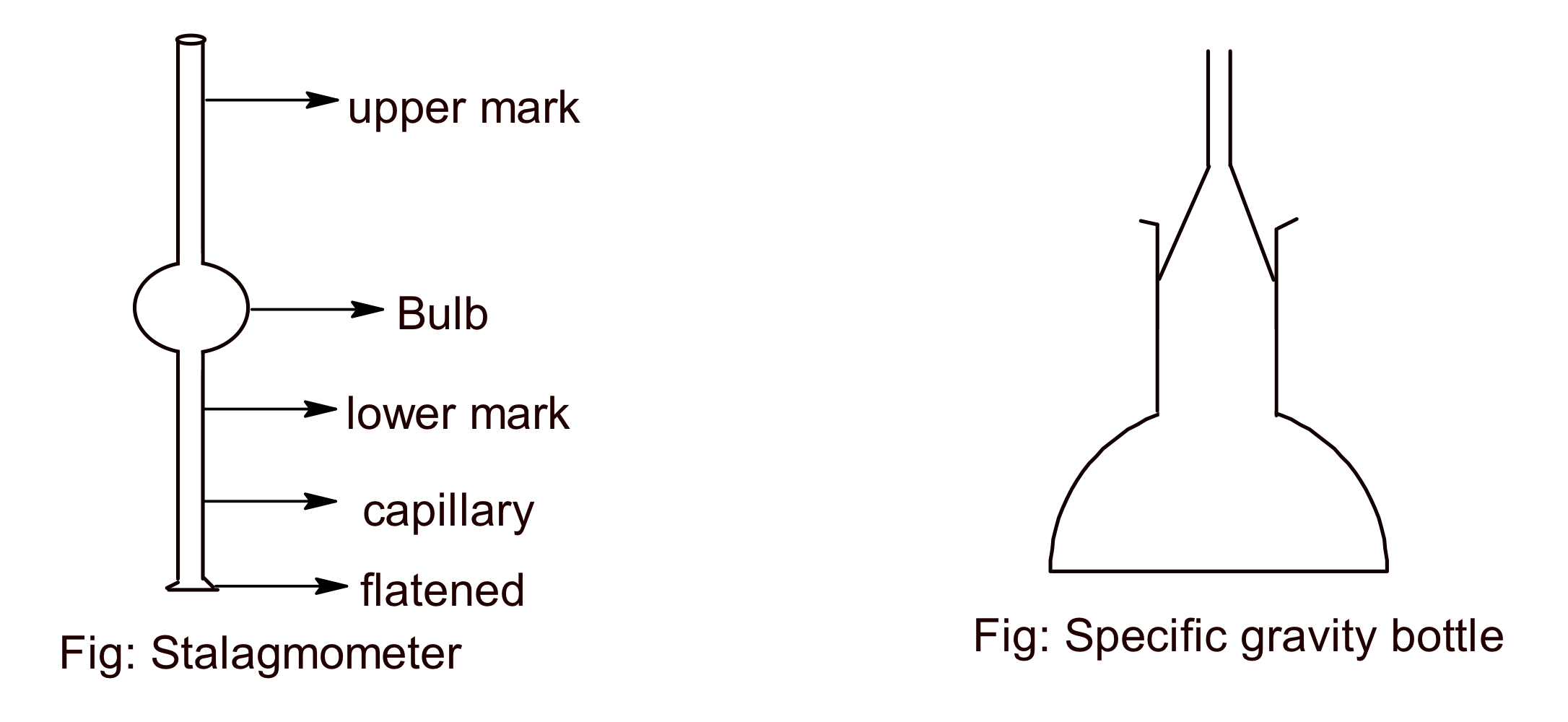
- Stalagmometer
- Specific gravity bottle
- Balance
- Rubber tube
CHEMICAL REQUIRED
Given liquid (alcohol)
THEORY
All the molecules of a liquid on the surface experience a resultant downward pull. This resultant downward pull or force of attraction which acts perpendicularly to any line of 1 cm length on the surface of the liquid is called the surface tension of the liquid. It is denoted by γ and its unit is dyne per cm (CGS) and Newton per meter (SI).
\begin{align*}
\frac{\gamma _{a}}{\gamma _{w}} &= \frac{n_{w}d_{a}}{n_{a}d_{w}}\\
\gamma _{a} &= \frac{n_{w}d_{a}}{n_{a}d_{w}} \times \gamma _{w}
\end{align*}
where,
γa = surface tension of alcohol
γw = surface tension of water
na = number of drops of alcohol
nw = number of drops of water
da = density of alcohol
dw = density of water
PROCEDURE
The stalagmometer was cleaned with chromic acid and then washed with water. The lower end was immersed in a beaker containing distilled water and it was sucked up until it was raised above the upper mark. The rate of flow of water was controlled with the help of a screw pinch cock so that the number of drops falling per minute becomes about 15-20. The counting of drops was started when the water meniscus just reached (passed the lover mark). The readings and their mean value were taken. The above process was repeated for the given liquid (alcohol).
The specific gravity bottle is cleaned and dried and its empty weight was taken out.
OBSERVATION TABLE
| S.N | Liquid | No. of drops | Mean drop |
|---|---|---|---|
| 1. | Water | i. 57 ii. 59 iii. 60 | 58.67 |
| 2. | Alcohol | i. 59 ii. 65 iii. 62 | 62 |
CALCULATIONS (Room temperature = 20oC)
Weight of empty specific gravity bottle = 9.13 gm
Weight of specific gravity bottle + water = 36.25 gm
Weight of water (mw) = 36.25 – 9.13 = 27.12 gm
Weight of specific gravity bottle + alcohol = 35.94 gm
Weight of alcohol (ma) = 35.94 – 9.13 = 26.81 gm
Surface tension of water at 20 °C(γw)=72.85 dyne/cm
Surface tension of alcohol (γa ) = ?
We know that,
\begin{align*}
\gamma _{a} &= \frac{n_{w}d_{a}}{n_{a}d_{w}} \times \gamma _{w}\\
&= \frac{58.67 \times 26.81}{62 \times 27.12}\times 72.85\\
&= 68.14\ dyne/cm
\end{align*}
RESULT
The surface tension of alcohol was found to be 68.14 dyne/cc.
CONCLUSION
The surface tension of liquid can be determined by the drop count method using a stalagmometer.
PRECAUTIONS
- The stalagmometer should be clean.
- Number of drops per minute should be between 15-20.
- The stalagmometer should be kept vertical.




Questions & discussion
Have a question, or found this note helpful? Be the first to comment.