


Experiment 12: TO PREPARE CARBON DIOXIDE GAS IN THE LABORATORY
OBJECTIVE
TO PREPARE CARBON DIOXIDE GAS IN THE LABORATORY AND INVESTIGATE ITS PROPERTIES.
APPARATUS REQUIRED
- Woulfe’s bottle
- Thistle funnel
- Delivery tube
- Cork
- Gas jars
- Test tube
CHEMICALS REQUIRED
- Dilute HCl
- Marble chips
- NaOH
- Litmus paper
- Mg ribbon
- Lime water
THEORY
Carbonates are decomposed by dilute mineral acids with effervescence. Carbon dioxide is prepared in the laboratory by the action of dilute hydrochloric acid on marble chips. This gas is produced according to the following chemical reaction.
Molecular reaction:
CaCO_{3}+2HCl\rightarrow CaCl_{2}+ H_{2}O+CO_{2}Ionic reaction:
CO_{3}^{--}+2H^{+}\rightarrow Ca^{++}+ H_{2}O+CO_{2}Dilute sulphuric acid is not used in this preparation. It is due to the formation of soluble calcium sulphate which covers the marble chips and prevents further contact of chips with acid, hence stopping the further formation of gas.

PROCEDURE
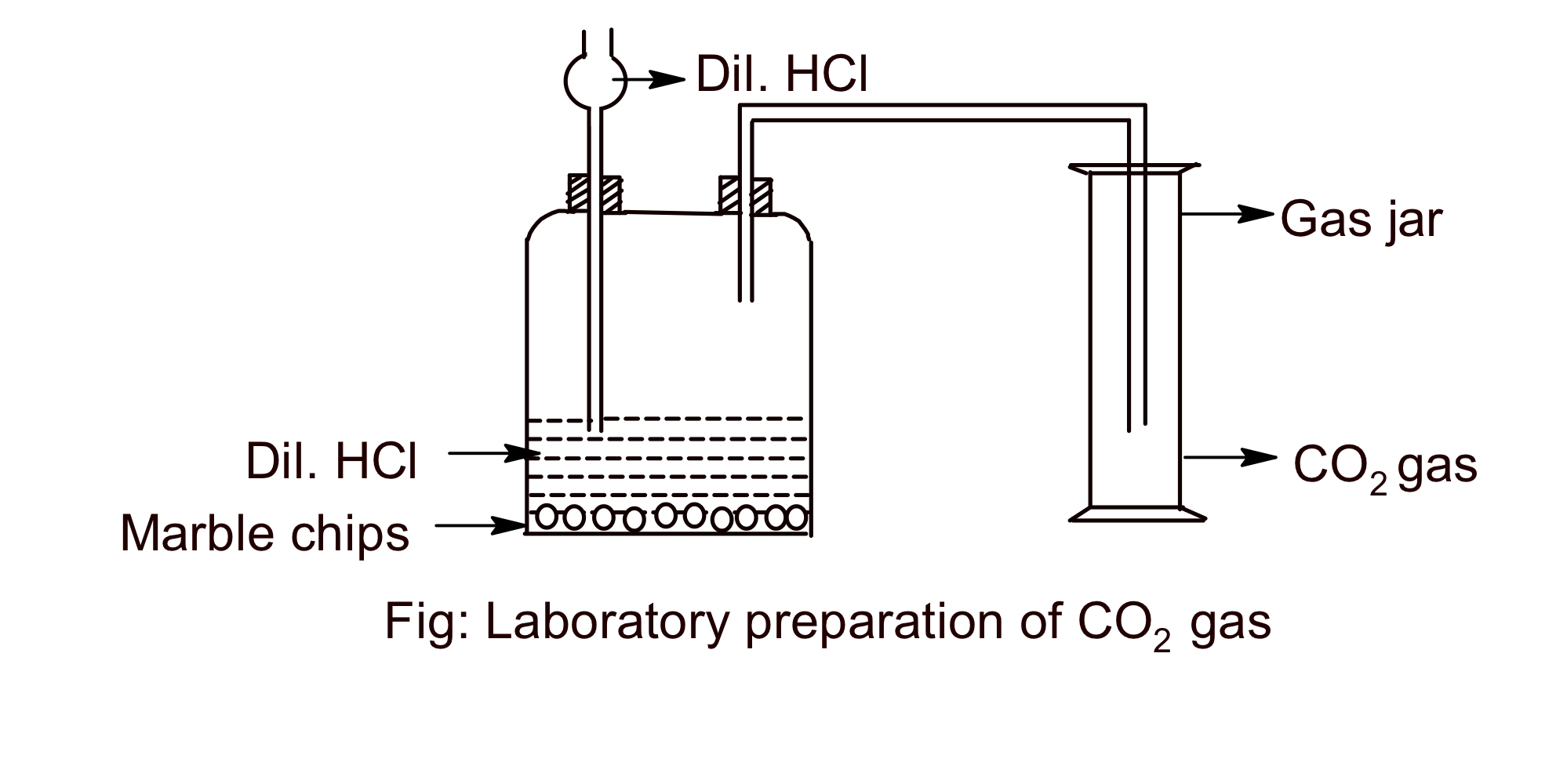
Some marble pieces were placed into the Woulfe’s bottle and water was poured over the marble chips. The apparatus was fitted as shown in the figure. Dilute hydrochloric acid was added through the thistle funnel such that the lower end of the funnel dips under the solution. Reaction occurs with effervescence. Since the gas is soluble in water and heavier than air, it was collected by upward displacement of air.
OBSERVATION TABLE
| Experiment | Observation | Inference |
|---|---|---|
| 1. The physical properties was noted i. Colour ii. Odour iii. Solubility: The gas jar filled with hydrogen gas was inverted over a water trough and moved it up and down for some time. | 1. i. No color ii. No odour iii. The level of water slightly raised in the jar. | 1. The gas is i. colourless ii. Odourless iii. Slightly soluble in in water. |
| 2. A burning candle was introduced into the gas jar full of CO2 gas. | 2. The burning candle gas extinguished. | 2. CO2 gas is neither combustible nor the supporter of combustion. |
| 3. A piece of burning magnesium was introduced into the jar full of CO2 gas. | 3. Magnesium burned forming black particles and white residue. | 3. CO2 gas can support the combustion of brilliantly burning Mg. |
| 4. Moist blue litmus paper was brought into contact with CO2 gas. | 4. Blue litmus paper turned faintly red. | 4. CO2 gas is weakly acidic. |
| 5. A test tube was filled with CO2 gas. A few drops of NaOH were added to it. Its mouth was closed with thumb, shaked and inverted over a water trough. | 5. The level of water rises up high in the tube. | 5. The gas is highly absorbed by NaOH solution. |
| 6. The gas was passed into the lime water taken in a test tube. | 6. Lime water turned milky white. | 6. Formation of white insoluble carbonate. |
| 7. The gas was continued to pass for some more time. | 7. The precipitate disappeared and the solution became colourless. | 7. Formation of soluble substances. |
| 8. The clear solution obtained in 7 was heated. | 8. Turbid precipitate reappeared. | 8. A white insoluble substance was formed again. |
REACTIONS INVOLVED
1. Action with water
CO_{2}+H_{2}O\rightarrow \underset{weak\ acid}{H_{2}CO_{3}}3. CO2 is decomposed by burning Mg.
CO_{2}+2Mg\rightarrow \underset{white}{2MgO}+\underset{black}{C}5. Action of NaOH
CO_{2}+2NaOH\rightarrow Na_{2}CO_{3}+H_{2}O6. Action with lime water
Ca(OH)_{2}+CO_{2}\rightarrow CaCO_{3}+ H_{2}O7. With excess CO2
CaCO_{3}+CO_{2}+ H_{2}O\rightarrow \underset{\underset{bicarbonate}{colorless\ soluble}}{Ca(HCO_{3})_{2}}8. Heating of calcium bicarbonate
Ca(HCO_{3})_{2}\rightarrow CaCO_{3}+H_{2}O+CO_{2}RESULT
Carbon dioxide gas is prepared in the lab and its properties are studied.
CONCLUSION
In this way, carbon dioxide gas is prepared in the laboratory and its properties are studied.
PRECAUTIONS
- Apparatus as fitted must be air-tight.
- The lower end of the thistle funnel must be under the surface of water.
- Dilute sulphuric acid is not used in this preparation instead of dilute hydrochloric acid.



Questions & discussion
Have a question, or found this note helpful? Be the first to comment.